The short answer
Helicopter tours operate year-round on Kauai, Maui, Oahu and the Big Island, and the weather on your exact flying day matters more than the month. Low cloud, poor visibility, strong wind and heavy rain can delay, reroute or cancel a flight in any season.
If your dates are still flexible, the months from May through September are generally the drier part of the year in Hawaii, which gives you a better chance of clear conditions. November through April brings more widespread rain and winter storms; waterfalls can be fuller after wet weather, but mountain visibility may be less reliable. Windward areas and mountain interiors can be cloudy or showery in any season.
Choose your Hawaii dates for the trip as a whole rather than for the helicopter tour alone. Once your island and dates are fixed, focus on the route and the day’s forecast. Morning can be a good choice for mountain-heavy flights, because cloud sometimes builds over the interior later in the day, but there is no universal best hour across every island and route.
Tours that fly over Haleakalā or Hawaiʻi Volcanoes National Park have legally restricted operating days and hours, so the earliest flight is not always available. Over Haleakalā, for example, tours in standard aircraft fly only between 11 a.m. and 2 p.m. Check the specific tour schedule before choosing your time.
Whatever season you visit, schedule your helicopter tour early in your stay. If the flight is cancelled for weather, you may still have time to fly on another day, as long as seats are available.
- Generally drier season
- May to September
- Fuller waterfalls after rain
- More likely November to April
- Time of day
- Depends on island, route and forecast
- Mountain-heavy routes
- Morning can have an advantage
- National park routes (check the tour)
- Restricted days and hours
- Sunset flights
- On some islands; check schedules
- When in your trip
- Early in your stay
- Most useful live checks
- Cloud, visibility, wind gusts, rain
- Haleakalā park tours, standard aircraft 11 a.m. to 2 p.m., not Sun or Wed
- Hawaiʻi Volcanoes park tours, standard aircraft 10 a.m. to 2 p.m., not Sun or Wed
- Rain at Lihue, June against December 1.8 in against 4.6 in
- Check-in before a flight typically 30 to 60 minutes; confirm with your operator
Current conditions, checked September 18, 2026
- Kauai: Hurricane Lowell passed the island on September 8, 2026. Local and state officials encouraged visitors to delay trips during the recovery, and the state closed all Kauai state parks, including Nā Pali Coast and Waimea Canyon, until further notice. Several helicopter operators report flying from Lihue, some with limited flight times, so confirm with your operator before you book.
- Big Island: Kīlauea was between eruptive episodes on September 17, 2026, with glowing vents and no flowing lava. Check the USGS volcano update on the morning of your flight.
- Maui and Oahu: no suspensions or heliport closures found.
Tour calendar and prices
The calendar below is for the Road to Hana helicopter and waterfall tour from Kahului on Maui, which includes a landing near a waterfall on private land. It holds 4.8/5 from 335 reviews on GetYourGuide (cancel up to 3 days in advance for a full refund). The calendar shows the dates, times and current prices you can actually book. Our page on the Hana rainforest flight explains what happens to its landing when cloud closes the Hana side. For the other islands, see our Kauai and Big Island guides.
Check your date
Choose your island and the day you plan to fly. Within about a week, the card shows the National Weather Service forecast for cloud over the island’s mountains in the morning and the afternoon, the chance of rain and the wind at the heliport. Further ahead it shows the long-run averages for that month, and it always says which one you are looking at.
Tours are available year-round; the weather over the mountains on your day decides whether you fly and what you see.
- Drier months
- May to September
- Wetter season
- November to April
- What the pilot checks
- Cloud, visibility, wind, rain
- Sunset, Honolulu
- about 5:49 p.m. to 7:18 p.m.
Pick an island and a date for that day’s mountain cloud, rain chance, wind gusts, temperature and sunset. The pilot and operator make the final decision to fly on the day.
Showing yearly patterns. Pick a date for the forecast or that month’s averages.
Before you fly: National Weather Service Honolulu · Kīlauea update
Check AvailabilityChoosing your Hawaii dates
Choose your dates for Hawaii as a whole rather than for the helicopter tour alone. May through September is generally drier, while winter brings more rain but can also mean greener scenery and stronger waterfalls. The National Weather Service describes a drier summer from May to October, when the trade winds blow about 90% of the time, and a wetter winter from October to April, when cold fronts and kona storms bring heavier rain, so October sits between the two. Humpback whales are in Hawaiian waters from November to April.
Where you fly matters as much as when. Moist trade-wind air rises over the windward slopes and mountains, so they catch cloud and showers in every season, while the leeward coasts, where the air sinks, are often sunny and dry on the same day. Once your island and travel dates are fixed, the exact-day flying conditions matter more than the month.
Morning, midday or sunset
Over the mountains, cloud often builds during the day. The National Weather Service describes towering cumulus clouds building over the mountains and interiors on sunny afternoons, and the Western Regional Climate Center notes that the high mountain slopes tend to become cloudier during the middle part of the day. On mountain-heavy routes, such as Kauai’s Waiʻaleʻale crater or the West Maui mountains, a morning flight can have an advantage, and Air Maui and Rainbow Helicopters both recommend mornings. There is no universal best time across Hawaii, though: Blue Hawaiian says that most of the time it makes no difference whether you fly in the morning or the afternoon, and Jack Harter and Safari Helicopters say there is no right or wrong time of day. Some mornings start cloudy on the windward coasts and clear later, so on the day, the route and the forecast matter more than the hour.
Routes over the two national parks are the exception. Under the parks’ air tour rules, tour flights over Haleakalā National Park on Maui can run from 11 a.m. to 2 p.m. (to 4 p.m. in quieter aircraft), and not on Sundays or Wednesdays. Over Hawaiʻi Volcanoes National Park on the Big Island, standard aircraft can fly from 10 a.m. to 2 p.m., and quieter aircraft from 9 a.m. to 5 p.m.; there are no park flights on Sundays. On those routes the earliest flight of the day is not always available, so check the specific tour’s schedule; the date checker shows how much cloud is forecast over the mountains that afternoon.
Sunset flights are offered on some islands, often only on certain days or at certain times of year. On Oahu, Rainbow Helicopters runs a Waikiki sunset flight over the city and Diamond Head, and on the Big Island, Mauna Loa Helicopters offers a private sunset flight along the Kona coast. Sunset in Honolulu ranges from about 5:49 p.m. to 7:18 p.m. through the year. Operators ask you to check in typically 30 to 60 minutes before the flight, and the time you book is a check-in time, not a take-off time. For sunset, choose a check-in time well before the sun goes down.
Other Hawaii Experiences You Might Enjoy
If the weather rules out a flight, most of these still run.
If cloud grounds your flight, the islands have plenty to fill the day. Travelers often pair a helicopter tour with a Nā Pali Coast boat trip on Kauai, a Molokini snorkel cruise or a Haleakalā sunrise tour on Maui, a Pearl Harbor visit on Oahu, or a Hawaiʻi Volcanoes National Park day tour on the Big Island. The picks below update automatically.
Rain by month on each island
The table gives the average rainfall for each month at the five airports nearest the main heliports. It shows the seasonal pattern clearly, but the airports sit near sea level, and the mountains the flights cross are much wetter: the summit of Waiʻaleʻale on Kauai is one of the rainiest places on earth. Use it to compare months, not to predict the weather on your flight.
| Month | Lihue | Kahului | Honolulu | Hilo | Kona | Sunset, Honolulu |
|---|---|---|---|---|---|---|
| January | 2.8 in | 2.4 in | 1.8 in | 7.9 in | 1.4 in | 6:10 p.m. |
| February | 3.6 in | 2.0 in | 1.9 in | 10.2 in | 1.2 in | 6:29 p.m. |
| March | 5.6 in | 2.6 in | 2.4 in | 12.7 in | 1.0 in | 6:41 p.m. |
| April | 2.0 in | 1.3 in | 0.8 in | 9.4 in | 0.6 in | 6:51 p.m. |
| May | 2.2 in | 0.7 in | 0.8 in | 7.0 in | 0.6 in | 7:02 p.m. |
| June | 1.8 in | 0.2 in | 0.5 in | 7.3 in | 0.8 in | 7:15 p.m. |
| July | 1.8 in | 0.5 in | 0.5 in | 9.2 in | 0.5 in | 7:17 p.m. |
| August | 2.3 in | 0.5 in | 0.8 in | 11.3 in | 0.5 in | 7:03 p.m. |
| September | 2.2 in | 0.5 in | 0.9 in | 8.7 in | 0.5 in | 6:35 p.m. |
| October | 3.3 in | 0.8 in | 1.5 in | 10.2 in | 0.9 in | 6:08 p.m. |
| November | 4.0 in | 1.8 in | 2.2 in | 14.4 in | 0.8 in | 5:51 p.m. |
| December | 4.6 in | 2.8 in | 2.2 in | 12.1 in | 1.1 in | 5:52 p.m. |
At Lihue, the wettest months are November to March, with December averaging 4.6 in of rain against 1.8 in in June. Kahului and Honolulu, on the drier sides of Maui and Oahu, get very little rain from May to September. Hilo and the windward Big Island are wet in every season, with rain on 10 to 19 days a month on average, so the summer–winter difference is less pronounced there than on Hawaii’s drier leeward coasts. Kona, on the sheltered west coast, is dry in every month. The totals are for the whole month, not a daily rate, so a wetter month usually means more showery days rather than rain all day.
What you see from the air through the year
November to April
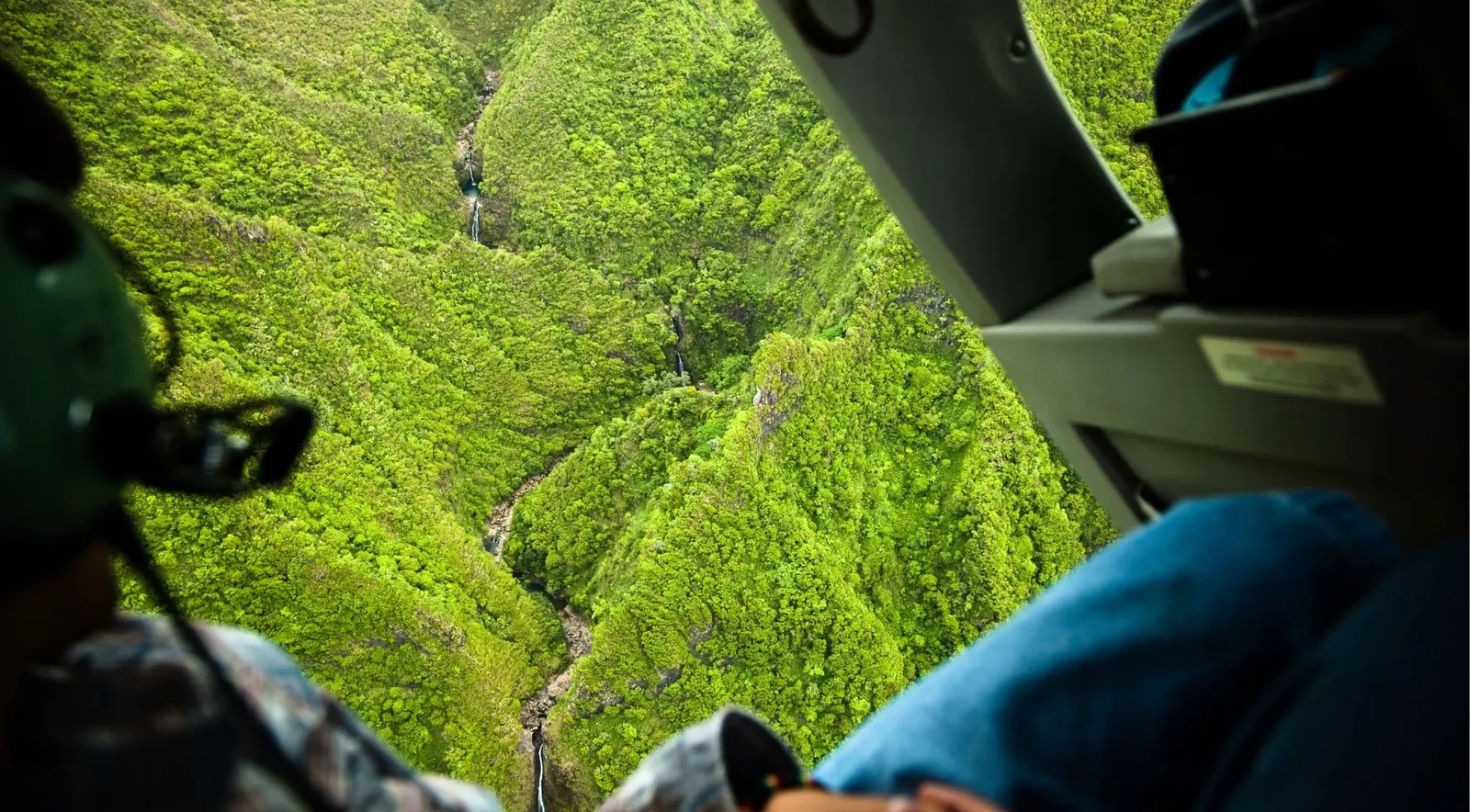
This is the wetter half of the year. Waterfalls can be fuller after periods of rain, particularly on Kauai, Maui and the windward Big Island, but visibility over the mountains is less reliable. On Kauai the Hanalei River carries its highest average flows from November to April, peaking in March, and on the Big Island the Wailuku River, which feeds Rainbow Falls, broadly follows the same pattern, although single storms can fill it in any month. After a wet spell the ribbon falls on the valley walls of Kauai and West Maui run in dozens of strands. Kona storms, most common from November to March, can bring days of heavy rain and southerly winds, and snow sometimes dusts the summits of Mauna Kea, Mauna Loa and occasionally Haleakalā. Humpback whales are in Hawaiian waters from November to April, most of all from January to March. Aircraft have to stay at least 1,000 feet from them, so a sighting from a helicopter is a possible bonus, not something a tour can promise.
May to September, and October
The trade winds are at their most steady, showers over the mountains are lighter, and the leeward coasts are dry and sunny. Waterfalls run lower than in winter, although a heavy shower can fill them again within hours. October is a changeover month: Maui and the Kona coast are still dry, but Lihue on Kauai already averages more rain in October than in January. The Central Pacific hurricane season runs from June 1 to November 30; most storms pass far from the islands, but Hurricane Lowell hit Kauai in September 2026, so check the National Weather Service before you fly in these months. Days are longer, too, although any month has plenty of daylight for a flight: even in December the sun is up for about 11 hours.
Island by island
Kauai. Most circle-island flights head for Waiʻaleʻale, Waimea Canyon and the Nā Pali Coast. The crater sits near the summit of one of the wettest mountains in the world and is often in cloud, so a morning flight can help there, although Nā Pali faces west and gets its best light later in the day. More on routes and operators in our Kauai helicopter tours guide.
Maui. West Maui and Molokaʻi flights can go in the morning; Hana and Haleakalā routes that cross the national park fly in its permitted hours around midday, when cloud is more likely over the crater. See the Maui helicopter tours guide.
Oahu. The short Waikiki and Diamond Head flights are the least affected by mountain cloud, and Oahu has the islands’ sunset flights. Longer routes over the Koʻolau mountains follow the same morning-is-usually-clearer pattern as the other islands.
Big Island. Hilo flights to Kīlauea and the Hilo-side waterfalls fly in the park window when they cross the national park, and on the wet east side a clear morning is never guaranteed. From Kona, volcanic haze (vog) from Kīlauea often collects along the west coast when the volcano is active, which can soften the views. Lava is only visible during a fountaining episode, which cannot be planned for. See the Big Island helicopter tours guide.
What cancels a flight, and what to do about it
The decision to fly is made on the day by the pilot and the operator. Low cloud over the route, poor visibility, strong or gusty wind and heavy rain are what delay, reroute or cancel flights; none of the operators we checked publishes exact limits. Passing showers are common in every season and do not usually stop a flight on a doors-on tour, but a flight may be rerouted to a clearer part of the island, which can mean missing the view you came for.
Whatever month you visit, schedule the flight for the first days of your stay, so there is time to fly on another day if yours is cancelled for weather and seats are still available. What you get back after a weather cancellation depends on how you booked: some operators refund in full and others offer a new date, and a GetYourGuide booking follows GetYourGuide’s terms and the cancellation window on the listing.
How busy it gets
None of the operators we checked publishes how full its flights are month by month, so the closest measure is how many visitors arrive on each island. In 2025, the state tourism office counted about 890,000 visitors arriving by air in March and about 871,000 in July, the two busiest months, against about 675,000 in September, the quietest. On Kauai the range ran from about 142,000 visitors in July to about 102,000 in September; on Maui, from about 244,000 in December to about 179,000 in October.
Across the state, September, October and November had the fewest arrivals, with February and May close behind, while March, June, July and December were the busiest. These are visitor arrivals, not bookings, so they show when the islands are busiest rather than how hard it is to get a particular flight. Once your dates are fixed, book ahead if you want a particular tour or time of day.
When to Take a Hawaii Helicopter Tour: Common Questions
What is the best month for a helicopter tour in Hawaii?
There is no single best month, because the weather on the day decides whether you fly and how much of the mountains you see. If your dates are flexible, May through September is generally the drier part of the year across Hawaii. November through April brings more widespread rain and winter storms; waterfalls can be fuller after wet weather, but mountain visibility may be less reliable. Windward areas and mountain interiors can be cloudy or showery in any month, and Hilo, on the Big Island's wet side, is rainy in every season.
What is the best time of day for a Hawaii helicopter tour?
There is no universal best time across every island and route. Morning can be a good choice for mountain-heavy flights, because cloud sometimes builds over the interior later in the day, and some operators recommend it; others say morning or afternoon usually makes little difference. Tours over Haleakalā and Hawaiʻi Volcanoes National Park fly only on set days and at set hours (standard tours over Haleakalā, for example, fly between 11 a.m. and 2 p.m.), so check the specific tour's schedule.
Do helicopter tours fly in the rain?
Often, yes. Passing showers are normal in Hawaii, and on a doors-on tour you are inside an enclosed cabin. What stops a flight is low cloud, poor visibility, strong wind or heavy rain along the route. The pilot and operator decide on the day, and a flight may be delayed, rerouted to a clearer part of the island or cancelled.
Can you see whales from a helicopter in Hawaii?
Sometimes, from a distance. Humpback whales are in Hawaiian waters from November to April, peaking from January to March, and pilots may point them out. Federal rules keep aircraft at least 1,000 feet from humpback whales, so a helicopter is not a whale-watching tour. If whales are a priority, book a boat.
Can you see lava from a helicopter on the Big Island?
Only sometimes. Since December 2024 Kīlauea has erupted in short fountaining episodes, usually lasting less than 12 hours and separated by pauses of two weeks or more. As of September 17, 2026, the vents were glowing but no lava was flowing. Tour routes over the national park also avoid the summit, so check the USGS Hawaiian Volcano Observatory update on the morning of your flight.
What happens if my helicopter tour is cancelled for weather?
It depends on how you booked. Some operators refund a weather cancellation in full and others offer a new date. A GetYourGuide booking follows GetYourGuide's terms and the cancellation window shown on the listing. Whatever month you visit, schedule the flight early in your stay, so there is time to fly on another day if seats are available.
Are there sunset helicopter tours in Hawaii?
Yes, on some islands, often only on certain days or at certain times of year. On Oahu there is a Waikiki sunset flight, and on the Big Island a private sunset flight along the Kona coast. Check-in is typically 30 to 60 minutes before the flight, so choose a check-in time well before the sun sets; the date checker on this page shows sunset for your island and date.
Can I take a Kauai helicopter tour after Hurricane Lowell?
Hurricane Lowell passed Kauai on September 8, 2026, and local and state officials encouraged visitors to delay trips while the island recovers. On September 16, 2026, the state closed all Kauai state parks, including Nā Pali Coast and Waimea Canyon, until further notice. Several Kauai operators report flying from Lihue, some with limited flight times, so confirm with your operator before you book.
How we know
Checked on September 18, 2026. Sources:
- Rainfall and temperature: NOAA National Centers for Environmental Information, 1991–2020 U.S. Climate Normals for Lihue (USW00022536), Kahului (USW00022516), Honolulu (USW00022521), Hilo (USW00021504) and Kona (USW00021510) airports. Rain days count days with 0.10 inch or more.
- Seasons, mountain cloud, trade winds and kona storms: National Weather Service Honolulu climate summary and FAQ; Western Regional Climate Center, Climate of Hawaii.
- Hurricane season: National Weather Service Central Pacific 2026 hurricane outlook.
- Waterfalls: USGS monthly stream-flow statistics for the Hanalei River near Hanalei (16103000) and the Wailuku River at Piʻihonua (16704000); monthly averages computed by us from the yearly monthly means.
- Whales: NOAA Hawaiian Islands Humpback Whale National Marine Sanctuary; 50 CFR 216.19 (aircraft within 1,000 feet of a humpback whale).
- Kīlauea: USGS Hawaiian Volcano Observatory notices of September 16 and 17, 2026.
- Park flight rules: National Park Service Air Tour Management Plans for Haleakalā (January 2024) and Hawaiʻi Volcanoes (December 2023), and the Ninth Circuit decision of June 9, 2025 that left the Volcanoes plan in place.
- Operator policies, check-in times and time-of-day advice: the operators’ own websites, checked on September 18, 2026.
- Sunrise and sunset: computed with the NOAA solar position method for each island’s main heliport, Hawaii-Aleutian Standard Time, and checked against an independent sunrise service to within two minutes.
- Visitor numbers: Hawaii Department of Business, Economic Development and Tourism, monthly visitor statistics by island, 2025 (preliminary): visitors arriving by air, where a visitor to several islands is counted on each one.
- Hurricane Lowell: Honolulu Civil Beat (September 8, 2026), Kauai Now (September 13 and 16, 2026) and the Department of Land and Natural Resources news release of September 16, 2026 on Kauai state park closures.
- Rating and reviews: the GetYourGuide listing for tour 168503, checked on September 18, 2026. Prices change with the option and date, so the page links to the live calendar instead of quoting one.
Where the evidence stops. The rainfall figures come from airports near sea level, while the flights cross mountains that are much wetter and cloudier, so they show the seasonal pattern rather than conditions on a route. None of the operators we checked publishes monthly cancellation rates or its weather limits, so the page does not claim a cancellation rate for any month, and the averages in the table are not a forecast for your flight day. The stream-flow averages are pulled up by individual storms. The morning-is-clearer advice is a tendency described by the National Weather Service and operators, not a measurement for each route. The National Weather Service forecast used in the date checker gives sky cover but not cloud height or visibility for these locations, and the checker’s thresholds are ours, not an operator’s. Visitor arrivals count people arriving on each island; the series does not measure how many people book air tours. The current conditions box describes September 18, 2026 and will change; we plan to recheck it by October 15, 2026.