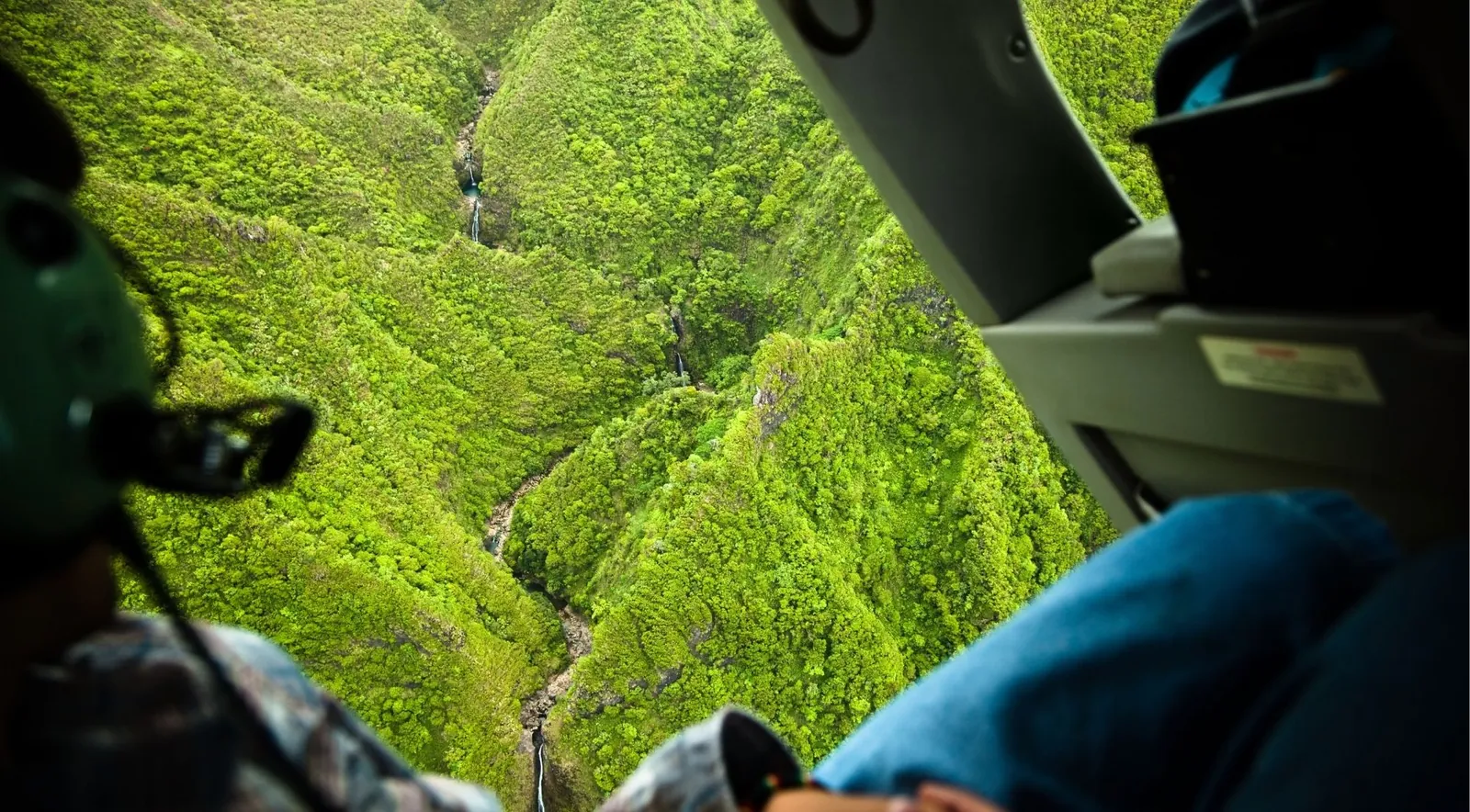
- 3,315 ft Molokai's sea cliffs, tallest on earth
- 4 operators all departing Kahului
- $250–$560 short flight to landing tour
- 2,224 / yr Haleakalā overflights allowed
- Air Maui the only doors-off operator
What a Maui Helicopter Tour Actually Shows You in 2026
The case for flying here is genuine — but two widely repeated claims about it are wrong.
The core argument holds: the West Maui interior, Honokohau Falls, Molokai's north-shore sea cliffs and much of the Hāna coastline are genuinely inaccessible by road or by any reasonable hike. Molokai's north shore in particular is "completely inaccessible by road or boat," so the air is the only way. That is what you are buying.
Two corrections before you book, because both appear on almost every operator and reseller page. First, the Haleakalā crater. Since a national-park plan took effect in January 2024, the authorised route avoids the crater — you will see its exterior slopes and the summit area, not its interior. Second, the waterfall claim. Operators routinely bill Honokohau Falls as "the tallest waterfall in Hawaii at ~1,749 ft." Authoritative geographic sources disagree, and we set out the real figures below.
Four operators fly Maui in 2026 — Air Maui, Blue Hawaiian, Maverick and Sunshine — mostly in Airbus EC130 EcoStar and AS350 AStar aircraft, all out of Kahului Heliport. Per-person prices run from about $250 for a short West Maui flight to $560 and up for a landing tour, and Air Maui is the only operator offering doors-off on this island.
The Maui Helicopter Tour We Recommend Starting With
West Maui and Molokai is the route most people book, and this is the version with the strongest review base.
Central Maui: Two-Island Scenic Helicopter Flight to Molokai
Why we recommend it: the West Maui & Molokai route is the most popular tour on the island, and at 192 verified GetYourGuide reviews this Maverick version has by far the strongest review base of any Maui two-island flight — the alternatives sit at 6 to 9 reviews. It also carries the island's most generous cancellation window at 3 days, where most Maui operators require 24 hours.
The 55-minute route crosses the Pailolo Channel from Kahului to Molokai's north shore — the tallest sea cliffs in the world — then works back over the deeply eroded interior of the West Maui Mountains, including Honokohau Falls and the rainforest of ʻĪao Valley State Park. Maverick flies the EC130 EcoStar with theatre seating and wraparound windows, doors-on.
- Molokai's north-shore sea cliffs, the world's tallest at ~3,315 ft
- Honokohau Falls — the tallest waterfall on Maui
- ʻĪao Valley State Park rainforest and the West Maui interior
- In-flight commentary from the pilot throughout
- Free cancellation up to 3 days before departure
Before you book. This is a doors-on flight — Maverick does not fly doors-off anywhere on Maui, and only Air Maui does. West Maui routes pass near the Lahaina burn zone; if you would rather not see it, ask about routing before booking, and see our note below. All passengers are weighed at check-in, and Maverick requires a double seat for passengers of 300 lb or more. Check-in is 30 minutes before departure at Kahului Heliport, where parking is paid.
What You See From the Air Over Maui
The wettest peak in Hawaii, the tallest sea cliffs on earth, and the largest tropical rainforest in the nation.
Puʻu Kukui and ʻĪao Valley
The deeply eroded interior of the West Maui Mountains (Mauna Kahalawai) centres on Puʻu Kukui, which averages about 386.5 inches (9,820 mm) of rain a year — one of the wettest spots on earth. USGS cites roughly 389 inches. Note that tour marketing often rounds this down to "360 inches" or calls the peak "the second wettest spot on Earth"; the higher figure is the documented average, and the superlative is not one you should rely on. It feeds the ribbon waterfalls that appear mainly after rain, plus the ʻĪao Valley headwall and the Launiupoko, Olowalu and Ukumehame valleys.
The tallest sea cliffs in the world
Per Guinness World Records: "The highest known sea cliffs in the world are those on the north coast of east Molokai… near Umilehi Point, which descend 1,010 m (3,300 ft) to the sea." That is about 3,315 ft — tour marketing's "3,000+ ft" is accurate but conservative. Reached by crossing the Pailolo and Auʻau Channels. You also see Halawa Valley and the Kalaupapa Peninsula, the former Hansen's-disease settlement.
The Hāna rainforest and the Road to Hana
The Hāna rainforest extends over 180 square miles — the largest tropical rainforest in the nation. From the air: the Keʻanae Peninsula taro fields, Wailua Falls, Kipahulu / ʻOheʻo Gulch (the "Seven Sacred Pools"), Old Hana Town, black-sand beaches, Hoʻokipa, the Jaws / Peʻahi surf break, Paia and Haiku. Much of the Hāna coastline's waterfalls are unreachable by land.
Molokini and the West Maui coastline
Molokini, the crescent islet crater, and the Lahaina and West Maui coastline including Kāʻanapali and Kapalua, are both visible from standard routes. The "Wall of Tears" — the many ribbon falls on Puʻu Kukui's flanks — and the "Keyhole Waterfall" are the other West Maui highlights operators name.
The Honokohau Falls claim: what operators say versus what the geography says
Operators and reseller pages routinely bill Honokohau Falls as "the tallest waterfall in Hawaii at ~1,749 ft." Authoritative geographic sources disagree, and you should know the real numbers before you pay a premium for the claim:
- Honokohau Falls is the tallest waterfall on Maui — a two-tiered fall totalling about 1,119 ft (341 m).
- Hawaii's tallest waterfall is ʻOloʻupena Falls on Molokai, at about 2,953 ft (900 m) — also among the tallest in the United States.
The "1,749 ft / tallest in Hawaii" figure could not be verified against a primary geographic source. Treat it as disputed marketing. Honokohau is genuinely spectacular and genuinely the tallest thing of its kind on this island — it just is not the state record, and the record-holder is visible on the same Molokai crossing.
Other Experiences You Might Enjoy on Maui
Forty-five minutes in the air, and a week to fill around it.
Most people book a flight alongside the things it passes over. The obvious pairings here are the Road to Hana by car — the same coastline the helicopter covers in minutes — and sunrise at the Haleakalā summit, which is how you actually get to see the crater interior the aircraft now routes around. On the water, Molokini crater is the snorkelling trip, humpback whales fill the Auʻau and Pailolo Channels from December to April, and ʻĪao Valley State Park puts you on the ground under the West Maui headwall. Here is what else is bookable nearby.
The Haleakalā Rule: Why Your Tour Cannot Fly Over the Crater
Operators still sell "Hāna & Haleakalā" tours. The park says the route avoids the crater. Both are true, and here is how.
Finalised 11 January 2024
The NPS and FAA finalised the Haleakalā Air Tour Management Plan, complying with a 2020 D.C. Circuit order under the National Parks Air Tour Management Act of 2000, after suit by the Hawaiian Islands Coalition Mālama Pono and PEER. It authorises up to 2,224 air tours per year, a 54% reduction from the existing average of 4,824 flights per year. The draft had proposed 2,412.
One direction, and around the crater
A single one-way west-to-east route over the southern area of the park, with a quarter-mile deviation buffer. In the NPS's own words: "The route avoids Haleakalā Crater, where sound levels are among the lowest recorded in any national park." Minimum altitudes are 2,000 ft AGL over land and 3,000 ft AGL over ocean, with no vertical "stacking."
11 a.m. to 2 p.m., five days a week
Park-airspace flights run 11 a.m. to 2 p.m. local on Monday, Tuesday, Thursday, Friday and Saturday, with quiet-technology aircraft permitted until 4 p.m. No-fly days are Sundays and Wednesdays, plus six commercial-free days tied to the Hawaiian Moon Calendar and Makahiki, and two cultural state holidays including Prince Jonah Kūhiō Kalanianaʻole Day on 26 March.
All-quiet-technology by 1 January 2033
Operators must convert to quiet-technology aircraft by 1 January 2033, and their operations specifications were amended no later than 7 July 2024. Unlike the Big Island's plan, no litigation, amendment or compliance dispute specific to the Haleakalā ATMP has surfaced for 2024 to 2026 — the Vertical Aviation International challenge targeted the Hawaiʻi Volcanoes plan, not this one.
What this means for the tour you are about to book
There is a genuine tension worth stating plainly. The NPS says the route "avoids Haleakalā Crater." Operator and reseller marketing still promises views "into" the crater, its cinder cones, and the Kaupo and Koʻolau Gaps. A Tripadvisor reviewer corroborates the restriction from the cabin: "our pilot told us they are restricted from flying right over top of it so we could only go around it."
Because the ATMP governs only airspace over the park plus a half-mile buffer, operators fly a compliant route while still showing the crater's exterior slopes and summit-area terrain. So: you can absolutely still fly a Haleakalā or East Maui tour and see the volcano's dramatic slopes and summit from outside — but do not expect to hover directly over or inside the crater. If the crater interior is what you want, drive to the summit instead.
And there is a scheduling catch. Clouds frequently obscure the summit after late morning, so the usual advice is to book early — but the park-airspace window does not open until 11 a.m. A Haleakalā-inclusive tour therefore carries a structurally higher chance of summit cloud than a West Maui flight taken at 8 a.m. That is a real trade-off, not a detail.
Sources: the NPS news release and parkplanning.nps.gov/HaleakalaATMP; nps.gov/hale; mauinow.com; nationalparkstraveler.org; spectrumlocalnews.com; civilbeat.org (August 2024); bluehawaiian.com; airmaui.com; hawaiitours.com; tripadvisor.com.
Which Maui Route Should You Book?
West Maui, Molokai, Hāna, circle island, landing, doors-off or private.
| Route | Duration | What it shows | Our pick on GetYourGuide |
|---|---|---|---|
| Short West Maui only | ~30 min | West Maui valleys and coastline — the cheapest way up | Not sold on GYG — book Blue Hawaiian's Eco-Star West Maui direct |
| West Maui & Molokai | ~45–50 min | The most popular. West Maui interior, Pailolo crossing, Molokai sea cliffs and waterfalls. Best for sea cliffs and waterfalls. | Maverick Molokai Voyage — 4.9 (192), from $369 |
| Hāna & Haleakalā / East Maui | ~45–65 min | Road to Hana coastline, rainforest, waterfalls, Haleakalā exterior slopes and summit. Best for volcano terrain and rainforest. | Air Maui, 45 min — 5.0 (21), from $396 |
| Circle / Complete Island | ~60–75 min | East and West Maui combined, often adding Molokai. The most comprehensive. | Maverick 3-Island Odyssey — 4.6 (6), from $469 |
| Landing tour | ~75–90 min | Blue Hawaiian's Ulupalakua Ranch landing (~20 min ground, refreshments, views of "both oceans"); Maverick's Hāna Rainforest Experience in the Wailua Valley (30–35 min ground, champagne); Air Maui's oceanfront landing (75 min) | Blue Hawaiian Spectacular + Ulupalakua — 5.0 (7), from $559 |
| Doors-off | 45 min | West Maui & Molokai route in the AS350 AStar. Air Maui only. | Air Maui doors-off — 4.9 (43), from $452 |
| Private charter | Varies | All major operators. The most expensive option by a distance — roughly $1,320 to $1,732+ per hour on a smaller operator. | Arrange direct with the operator |
Two other Maui flights worth knowing: Maverick's Hāna Rainforest Experience with a Wailua Valley landing of about 30 minutes — 4.8 (335), which is the site's overall top pick (our Hana rainforest tour page covers the landing, seating and weather rules in detail); and Blue Hawaiian's Waterfalls of West Maui and Molokai — 4.9 (7), from $419, which covers 88 miles of untouched coastline. Air Maui also sells a West Maui and Molokai Special, 45 minutes — 5.0 (9), from $396. Note that the three Blue Hawaiian and Air Maui listings carry only 7 to 9 reviews each; the Maverick flights are the ones with a meaningful sample. Note too that the GetYourGuide prices above sit above the operator-direct figures in our pricing table — Air Maui's Hāna flight is $396 here against $200 plus $120 fuel booked direct, and its doors-off is $452 here against $269 plus $150. That gap is exactly the reseller-versus-direct trade-off, and it is worth checking both before you book.
Who Flies Maui in 2026
Aircraft, tours, safety credentials and the one that does doors-off.
Air Maui Helicopters
Kahului Heliport, flying the Airbus AS350 "AStar" — 6 passengers, forward-facing, air-conditioned, Bose headsets, MultiVision video. Claims a "perfect safety record over 25 years" — owner and chief pilot Steve Egger's line is "If it's not perfect, it doesn't fly." The only operator offering doors-off on Maui. Sister company to Air Kauai. The fuel surcharge is itemised separately at roughly $120 to $150. Tours: West Maui & Molokai (45 or 60 min), Molokai & West Maui Special (45 min), Hāna & Haleakalā (45 min), Complete Island (60 min), West Maui & Molokai with oceanfront landing (75 min), and doors-off West Maui & Molokai (45 min).
Blue Hawaiian Helicopters
Legal name Helicopter Consultants of Maui, at Kahului Heliport, 1 Lelepio Place. The largest and most established operator, flying on all islands, in the Airbus EC130 "Eco-Star" and some AS350. The only current Hawaii TOPS member; its pilots are State of Hawaii Certified Tour Guides and it claims the FAA Diamond Award, ISBAO Level 3, FAA ASAP and the HAI Platinum Program of Safety. Tours: Waterfalls of West Maui & Molokai (~50 min), Hāna & Haleakalā (~45–50 min), Complete Island, the Maui & Molokai Spectacular with Ulupalakua Ranch landing (~90 min), Pau Hana West Maui plus landing, and private charter.
Maverick Helicopters
Kahului, and also Kauai and Las Vegas / Grand Canyon. Flies the EC130 EcoStar with theatre seating and wraparound windows. Three tours: The Molokai Voyage (West Maui & Molokai), The Hawaiian Odyssey (circle island, ~60–70 min, sold on GetYourGuide as the 3-Island Hawaiian Odyssey), and The Hāna Rainforest Experience — a landing tour in the Wailua Valley, a former taro plantation, with a champagne toast, running about 75 minutes total: about 20 minutes of flight each way plus about 30 minutes on the ground, per Maverick's own tour page (the GetYourGuide description says 35). Doors-on only.
Sunshine Helicopters
Kahului, in the General Aviation area at 107 Airport Road, flying the EC130 B4 "WhisperStar." Also operates on Kauai and the Big Island. Three Maui tours — West Maui & Molokai (~45–60 min) and Hāna rainforest / circle routes. Offers "First Class" front seating, two seats with a combined weight limit around 490 lb, and markets a strong safety record. One caveat: Sunshine self-describes as TOPS-certified in some marketing, but the Vertical magazine member roster names Blue Hawaiian and not Sunshine. Treat that claim as unverified.
Smaller operators and fixed-wing
Pacific Helicopters runs private tours only, on a three-island itinerary. Mauiscape Helicopters is a smaller operator doing private charter and filming or photography work. Fixed-wing aeroplane tours exist as a smoother, cheaper, less manoeuvrable alternative. None of these are sold through GetYourGuide.
Everyone flies from Kahului
All main helicopter operators depart Kahului, and none currently runs scheduled tours from a Kapalua or West Maui base — so if you are staying in Kāʻanapali or Kapalua, budget the drive. Reassuringly, no major Maui operator closure, suspension or ownership change surfaced in 2025 or 2026: Air Maui, Blue Hawaiian, Maverick and Sunshine are all confirmed flying. That is a notably calmer picture than Kauai, where two operators are suspended or reportedly grounded.
What a Maui Helicopter Tour Costs in 2026
The headline price and the price you pay are two different numbers on this island.
| Route | Representative price | Notes |
|---|---|---|
| Short West Maui (~30 min) | ~$369 list; ~$250 discounted | Blue Hawaiian |
| West Maui & Molokai (~45–50 min) | ~$419 direct (Blue Hawaiian); Air Maui $209 + $150 fuel = $359; reseller specials from $249.95 | The most popular route on the island |
| Hāna & Haleakalā (~45 min) | Air Maui $200 + $120 fuel = $320; Blue Hawaiian ~$305–$335 | Subject to the 11 a.m. park window |
| Circle / Complete Island (~60–75 min) | ~$400–$500+ | Most comprehensive route |
| Doors-off (Air Maui, 45 min) | $269 + $150 fuel = $419 open seat; ~$390 discounted | The only doors-off on Maui |
| Landing tours | Maverick Hāna Rainforest ~$399, some listings $249 + $110 fuel/landing = $359; Blue Hawaiian Spectacular with landing ~$559 | 75–90 minutes |
| Private charter | ~$1,320–$1,732+ per hour | Smaller-operator example |
Air Maui itemises its fuel surcharge — the others mostly don't
This is the single biggest source of Maui price confusion. Air Maui's advertised fare excludes a fuel surcharge of roughly $120 on shorter tours and $150 on longer or doors-off flights. A "$209" West Maui and Molokai flight is $359 at checkout. Always compare all-in numbers, not headline ones.
Front seats and the weight thresholds
Front-seat upgrade: Air Maui charges $100 a seat and you must buy both, so $200, with a combined weight limit of 380 lb. Blue Hawaiian's front row requires a combined weight under 470 lb with no individual over 240 lb. Sunshine's "First Class" pair is capped around 490 lb combined.
Comfort seat: all passengers are weighed at check-in. Air Maui's single-passenger maximum is roughly 230 to 240 lb and a couple about 400 to 420 lb, 380 in front; over the limit, you buy a comfort seat, which roughly doubles the fare — an extra $419 on the doors-off flight, for instance. Blue Hawaiian's maximum is about 250 lb a guest, and Maverick requires a double seat at 300 lb and over.
Children
Under-2s fly free on a lap. The FAA requires anyone aged 2 and over to purchase a seat. Doors-off usually sets a minimum age of about 4.
Resellers versus direct
Third-party resellers — Viator, Maui Tickets For Less, Auntie Snorkel, Hawaii Discount, LeaLea, Tom Barefoot's, bestofmauiactivities and mauiactivities — advertise discounts "up to 50%" or specials from $249.95, and sometimes genuinely beat the operator websites. Always compare the all-in price including fuel surcharge and tax. Common discounts: online booking, early-bird or first-flight, standby, and kamaʻaina and military rates.
Doors-Off on Maui: Air Maui and Nobody Else
Blue Hawaiian, Maverick and Sunshine are all doors-on. If you want the open door here, there is exactly one choice.
Air Maui is the only operator offering doors-off on Maui in 2026. The route is West Maui & Molokai, 45 minutes, in the AS350 AStar, priced at $269 plus a $150 fuel surcharge — $419 for an open seat.
Who should book it
- Photographers wanting glare-free, unobstructed frames — the whole point
- Adrenaline seekers after a more immersive flight
- Anyone who has already done a doors-on tour and wants the contrast
- A four-point harness is used, and jackets are provided
Who really shouldn't
- Children — most operators bar under-4s and the practical minimum is higher
- Anyone prone to motion sickness or afraid of heights
- Anyone wanting to bring a DSLR or tablet — it is cell-phone only
- Anyone who dislikes being cold: it is windier, louder and colder than doors-on
The restrictions, precisely
Cell-phone-only camera policy — no loose cameras, bags, hats or loose items of any kind, because a dropped object goes into the rotor. Closed-toe shoes are mandatory. Hair must be tied up. You are secured in a four-point harness and a jacket is provided. Expect it to be windier, louder and colder than the doors-on equivalent, which is exactly the trade you are making for the photographs.
Lahaina: What Operators Do, and What You Should Ask
West Maui routes pass near the burn zone. You can ask to be routed away from it.
The 8 August 2023 Lahaina wildfire was the deadliest US wildfire in over a century. The death toll rose to 102, per the Associated Press, after a March 2024 hospice death; the 101st victim was confirmed in February 2024.
Air Maui halted tours over Lahaina town out of respect. Director of operations Richie Olsten said in April 2024 that the company had run about 30 tours a day before the fire, down to as few as one a day afterwards.
West Maui and Molokai routes still pass near the burn zone. If you would rather not see it, ask your operator before booking how they route over Lahaina, and whether they can put you on a Hāna-side itinerary instead — most will accommodate the request. Community guidance, through the Hawaii Tourism Authority's Makaukau and Mālama Maui campaigns and echoed by Fodor's and local businesses including Māla Ocean Tavern, strongly discourages "disaster tourism": no photographs of the burn zone even from a distance, and no entering restricted areas.
On the ground as of spring 2026: Lahaina Harbor began a phased reopening on 15 December 2025, Kāʻanapali and Kapalua resort areas are fully operating, and the Front Street burn zone and Banyan Tree Park remain closed. Tourism recovery in 2026 is uneven — DBEDT and UHERO forecasts show softer arrivals but strong per-visitor spending, which is a long way of saying the most useful thing a visitor can do is spend money with local businesses.
How Safe Are Maui Helicopter Tours?
Hawaii's fatal air-tour crashes cluster on the Nā Pali Coast, not here. That is the honest headline.
Part 135, Part 136 and a 1,500 ft floor
Operators hold FAA Part 135 air-carrier certification. 14 CFR Part 136 subpart D sets special operating rules for Hawaii air tours, including the 1,500 ft AGL minimum altitude under §136.75(d)(1) and mandatory personal-flotation and float systems.
20 accidents and 24 fatalities in four years
After a spike in Hawaii air-tour accidents — 20 accidents and 24 fatalities between 1991 and 1994 — the FAA implemented SFAR 71 in 1994 with the 1,500 ft minimum. The peer-reviewed Johns Hopkins Bloomberg School study (Haaland et al.) found that afterwards the sightseeing-helicopter crash rate fell from 3.4 to 1.8 per 100,000 flight hours — a 47% decrease — with ocean crashes dropping from eight to one. SFAR 71 was made permanent effective 26 October 2003 and folded into Part 136. Some operators still contest the rule, arguing it forces flight near cloud ceilings.
Blue Hawaiian is the confirmed TOPS member
Blue Hawaiian was "the first company in the US to be certified under TOPS" and is the current Hawaii TOPS member, last audited September 2023. It also cites ISBAO Level 3, FAA ASAP and the HAI Platinum Program of Safety. Sunshine self-describes as TOPS-certified in some marketing — but the Vertical magazine member roster names Blue Hawaiian and not Sunshine, so treat that as unverified. Air Maui separately claims a perfect safety record over 25 years, with no accidents or incidents.
Where Hawaii's crashes actually happened
At least 16 people died in Hawaii helicopter crashes in the roughly seven years to 2026. The key events: April 2019, Oʻahu — 3 dead; 26 December 2019, Safari Aviation near Kekaha on Kauai's Nā Pali — 7 dead in an AS350 B2, with the NTSB blaming the pilot flying into deteriorating weather and faulting FAA oversight (Chair Homendy: "100% preventable"); 11 July 2024, Kauai / Nā Pali — 3 dead in a Robinson R44 in-flight breakup from mast bumping; and 26 March 2026, Airborne Aviation, Kauai / Nā Pali — 3 dead, 2 injured, still under NTSB investigation. Many are weather-related VFR-into-IMC events, and they cluster on the Nā Pali Coast, not Maui. No major Maui-specific fatal tour crash surfaced in recent years.
The one open regulatory item: Blue Hawaiian's 700-ft petition
Blue Hawaiian has petitioned the FAA under docket FAA-2025-0301 for an exemption from §136.75(d)(1) to fly as low as 700 ft AGL in specified areas, and 500 ft on razorback ridge crossings — first on Kauai, with comments closing 8 April 2025, then statewide across Oʻahu, Maui, Molokaʻi and the Big Island, with comments closing 8 September 2025. It generated more than 55,000 public comments, mostly opposed.
As of late 2025 the FAA had not ruled and the petition remains pending — Hawaii News Now reported on 28–29 October 2025 that the FAA "is still deciding," and KHON2 that "the 1,500-foot minimum altitude rule… remains in place." No final disposition has surfaced as of August 2026. Treat it as an open, watch-this-space item: if it is granted, the flying experience over Maui changes materially.
Six questions to ask before you book
Is the operator Part 135 certified? Is it a TOPS member — and if it claims to be, does the official roster agree? What aircraft type, engine count and age? What is the pilot's experience and hours, and are they instrument-rated? What is the weather-cancellation policy? Does the company run a formal Safety Management System?
Sources: PMC4888595 (Johns Hopkins / Haaland et al. via the PMC review of the US commercial air tour industry); federalregister.gov on SFAR 71 (2003, 2007) and docket FAA-2025-0301; bluehawaiian.com/about/safety; verticalmag.com; ntsb.gov; beatofhawaii.com; civilbeat.org; mauinews.com; staradvertiser.com; khon2.com; hawaiinewsnow.com.
Booking and Preparing for a Maui Helicopter Tour
Check-in, the weigh-in, what to wear and what you cannot bring.
Book 1 to 2 weeks ahead
In peak season — December to March and June to August — book one to two weeks out. Schedule the flight early in your trip so you have backup days if weather cancels.
Check-in
Typically 30 minutes before departure at Kahului Heliport, though Blue Hawaiian's own GetYourGuide listings ask for 45. Photo ID is required. Parking at the heliport is paid, which surprises people.
Weight and balance
All passengers are weighed at check-in and seating is assigned by weight, with lighter guests often placed up front. Over the thresholds you must buy a comfort seat. Front seats can be bought — Air Maui at $100 a seat for both, combined under 380 lb; Blue Hawaiian's front row combined under 470 lb with no individual over 240 lb.
What to wear and bring
Dark or solid clothing to cut window glare in photographs. Closed-toe shoes, mandatory for doors-off. Sunglasses and a light cover-up. A polarising filter reduces glare if you are shooting through glass.
What is prohibited
Large cameras and tablets that block other passengers' views. For doors-off, anything loose at all — bags, hats, DSLRs — it is cell phone only.
Cameras and GoPros
Doors-on generally allows phones, small cameras and strapped GoPros. Doors-off is cell-phone-only. Check the specific operator's rule before you pack, not at the desk.
Children and infants
Under-2s fly free on a lap; the FAA requires anyone aged 2 and over to buy a seat. Doors-off minimum age is usually about 4.
Motion sickness
Morning flights are smoother because the winds are calmer. Consider medication beforehand if you are susceptible.
Cancellation policy
Weather cancellations are common on Maui and operators reschedule or refund. Blue Hawaiian requires 24 hours' notice to change or cancel, charging 100% inside that window — but a weather cancellation by the operator is fully refundable.
When to Fly Maui
The best slot and the park's permitted window do not overlap, and that is a real problem.
Time of day: morning, strongly
Calmer trade winds and fewer clouds. Cloud builds over Puʻu Kukui and Haleakalā as the day heats up, often obscuring the summits by midday or afternoon, and afternoon winds are stronger and can force route changes. A common recommendation is around 10 to 10:30 a.m. — late enough for early cloud to burn off, early enough to beat the afternoon build-up. Many advise simply booking the first flight of the day.
The Haleakalā conflict
Here is the trade-off nobody mentions at booking. Park-area flights are restricted to 11 a.m. to 2 p.m., or to 4 p.m. for quiet-technology aircraft, on Monday, Tuesday, Thursday, Friday and Saturday. That window is later than the ideal early-morning slot, so a Haleakalā-inclusive tour carries a structurally higher chance of summit cloud than a West Maui flight taken at 8 a.m. If clear summit views matter more than the Haleakalā box being ticked, fly West Maui early instead.
Windward versus leeward
The wet windward Hāna side in the northeast is lush and carries the most waterfalls; the leeward Lahaina and west side is dry. Winter rains from December to March push the windward and Road-to-Hana waterfalls to their fullest — the ribbon falls on Puʻu Kukui appear mainly after rain, so a dry week means a thinner show.
Whale season, December to April
Humpbacks are in the Auʻau and Pailolo Channels roughly December to April, with migration running December to May. They are visible from helicopters, especially on the Molokai channel crossing, and pilots point them out in season. Set expectations, though: a helicopter is not a dedicated whale platform, and the federal 100-yard approach rule applies to vessels and drones rather than to tour-altitude overflight.
Multi-Island From Maui: Molokai Yes, Big Island No
The channel crossing to Molokai is standard. The one to the Big Island is not a helicopter flight at all.
Maui to Molokai and Lanai — standard
Both are seen on standard West Maui & Molokai tours, and Maverick's 3-Island Odyssey adds Lanai and Shipwreck Beach. Inter-island charter and transfer services also exist — Go Fly Maui runs charters, and Paradise Helicopters operates primarily Oʻahu and the Big Island.
Maui to the Big Island volcano — a combo, not a flight
There are no regularly scheduled single-helicopter tours across the channel to the Big Island; it would be cost-prohibitive, with private charter running into the thousands. As Tom Barefoot puts it: "There are no regularly scheduled helicopter tours that will take you from Maui to the Big Island." The standard product is a combo day tour — an inter-island fixed-wing flight, Maui to Hilo and sometimes via Oʻahu, plus a roughly 45-minute Big Island helicopter tour over Hawaiʻi Volcanoes NP, plus ground touring. Budget 10 to 12 hours and from about $989 on some listings, with round-trip airfare included; the helicopter portion, around $350, is refundable if weather cancels. Fixed-wing-only volcano air tours from Maui also exist out of Kahului and Kapalua, running 2+ hours.
Maui to Kauai
Combo packages exist but require connecting flights, usually via Oʻahu with roughly 40-minute layovers. There is no direct helicopter crossing. Our Kauai guide covers what to book once you are there.
One thing worth knowing if the volcano is the draw
Kīlauea has been in an episodic eruption since late 2024, with 48-plus numbered episodes by mid-2026, and that has heightened demand for the Big Island combo trips. But lava viewing is never guaranteed — episodes are short and unpredictable, and since December 2023 no air tour may overfly the Kīlauea summit at all. Our Big Island guide sets out the current eruption status and exactly what the route restrictions allow.
What's New on Maui, and What Is Still Unresolved
A pending altitude ruling, a new lodging tax, and a county council pushing back on noise.
-
Blue Hawaiian's 700-ft petition is still pending
Docket FAA-2025-0301 remained undecided as of late 2025, with no ruling surfacing by August 2026. If granted, tour helicopters could descend to 700 ft in named areas and 500 ft on ridge crossings — changing the flying experience and reigniting the noise and safety debate.
-
The Haleakalā ATMP is in force and uncontested
No litigation, amendment or compliance dispute specific to it has surfaced. Unlike the Big Island's plan, which the industry challenged and lost, this one has simply been absorbed into how operators fly.
-
Maui County is pressing the FAA on helicopter noise
The Maui County Council has passed Resolution 22-7, from Council Vice-Chair Keani Rawlins-Fernandez, urging better FAA regulation of helicopter operations and citing impacts on Molokaʻi including livestock disruption, and Resolution 22-74, from Council Member Yuki Lei Sugimura, seeking a community roundtable. The Maui Tomorrow Foundation remains an active environmental advocate, though its recent public focus has been coastal development and water rather than helicopters specifically. Local opposition to lower-altitude flying is ongoing.
-
The Green Fee raised the lodging tax on 1 January 2026
Act 96 (SB 1396), signed 27 May 2025, raised the Transient Accommodations Tax from 10.25% to 11%, a rise of 0.75 points, — the nation's first climate "Green Fee," projected to raise about $100M a year for conservation and fire mitigation including clearing invasive grasses. Combined lodging taxes, with up to 3% county and roughly 4.5% GET, now reach 18 to 19%. On 31 December 2025 a federal judge blocked the portion applying the tax to cruise-ship cabins in a Cruise Lines International Association suit, with litigation continuing, while the hotel and vacation-rental portion took effect and survived the initial legal test. It raises your overall trip cost but does not directly tax helicopter tours. Separately, helicopter prices have edged up and fuel surcharges remain separately itemised, notably at Air Maui.
Sources: mauinow.com on the 2022 council resolutions; mauitomorrow.org; wane.com; avalara.com; governor.hawaii.gov; beatofhawaii.com; hawaiisbesttravel.com; deeparrival.com; hawaiinewsnow.com and khon2.com on the FAA petition.
Looking for the Jurassic Park Locations? They Are Not on Maui
If that is why you are booking a Maui helicopter, book a different island.
The iconic Jurassic Park scenery is on Kauai, not Maui. That means Manawaiopuna Falls — the "Jurassic Falls" the helicopter lands beside in the film — along with the arrival valley, Hanapepe Valley; Allerton Garden and Limahuli Garden of the National Tropical Botanical Garden; and the Nā Pali Coast. The Gallimimus stampede was filmed on Oʻahu at Kualoa Ranch. Minor first-film shooting touched Maui at Haiku and Niihau, and Molokai stood in for the "Isla Sorna" beaches in Jurassic Park III.
Maui operators nonetheless market a "Jurassic Rock" formation on the Hāna coast and a "Jurassic Park Waterfall" in Honokahua Valley, and lean on "Jurassic Park energy" language. That is not dishonest — the scenery genuinely is lush lost-world terrain — but it is not the film locations. If you specifically want the real thing, including the only tour that lands at Manawaiopuna Falls, that is a Kauai booking.
Maui Helicopter Tours: Common Questions
Routes, the crater rule, prices, doors-off, Lahaina and safety.
Which Maui helicopter tour should I book?
West Maui & Molokai, around 45 to 50 minutes, is the most popular route and the one we recommend starting with — it crosses the Pailolo Channel to Molokai's north shore, the tallest sea cliffs in the world, then covers the West Maui interior and Honokohau Falls. Choose Hāna & Haleakalā instead if rainforest and volcano terrain are the draw, a circle island flight at 60 to 75 minutes if you want everything, or a landing tour at 75 to 90 minutes if you want time on the ground. Doors-off is available on one route from one operator.
Can you fly over the Haleakalā crater?
No — not since January 2024. The Haleakalā Air Tour Management Plan, finalised 11 January 2024, authorises up to 2,224 air tours a year, a 54% cut from the previous average of 4,824, on a single one-way west-to-east route that in the NPS's words "avoids Haleakalā Crater, where sound levels are among the lowest recorded in any national park." Operators still sell "Hāna & Haleakalā" tours and you will genuinely see the crater's exterior slopes and summit-area terrain — but not the interior, and there is no hovering over it. One Tripadvisor reviewer's pilot put it plainly: "they are restricted from flying right over top of it so we could only go around it." If the crater interior is what you want, drive to the summit.
Is Honokohau Falls really the tallest waterfall in Hawaii?
No — that is disputed marketing. Operators and resellers routinely bill it as "the tallest waterfall in Hawaii at ~1,749 ft," a figure that cannot be verified against a primary geographic source. What the geography actually says: Honokohau Falls is the tallest waterfall on Maui, a two-tiered fall totalling about 1,119 ft (341 m). Hawaii's tallest is ʻOloʻupena Falls on Molokai, at about 2,953 ft (900 m), also among the tallest in the United States. Honokohau is still spectacular and still the island record — it is just not the state one, and the actual record-holder is on the same Molokai crossing.
How much does a Maui helicopter tour cost?
The overall cited range is $247 to $898 per person for 45 to 75 minute flights. A short West Maui flight of about 30 minutes lists around $369, discounted to about $250. West Maui & Molokai is about $419 direct with Blue Hawaiian, or Air Maui's $209 plus $150 fuel surcharge = $359, with reseller specials from $249.95. Hāna & Haleakalā is Air Maui's $200 plus $120 fuel = $320, or $305 to $335 with Blue Hawaiian. Circle island runs $400 to $500+. Doors-off is $269 plus $150 fuel = $419. Landing tours run from about $359 to $559. Private charter is $1,320 to $1,732+ an hour.
Why is the price at checkout higher than the one advertised?
Because Air Maui itemises its fuel surcharge separately — roughly $120 on shorter tours and $150 on longer or doors-off flights. A "$209" West Maui and Molokai flight is $359 all-in. Other operators mostly bundle it. Beyond that, if you exceed the weight thresholds you must buy a comfort seat, which roughly doubles the fare, and front seats are a paid upgrade. Always compare all-in numbers rather than headline ones, and check whether a reseller's "up to 50% off" special includes the surcharge and tax.
Who offers doors-off helicopter tours on Maui?
Air Maui, and only Air Maui. Blue Hawaiian, Maverick and Sunshine are all doors-on. The route is West Maui & Molokai, 45 minutes, in the AS350 AStar, at $269 plus a $150 fuel surcharge — $419 for an open seat. The restrictions are strict: a cell-phone-only camera policy with no loose cameras, bags, hats or loose items of any kind, mandatory closed-toe shoes, hair tied up, a four-point harness, and jackets provided. It is windier, louder and colder than doors-on. Most operators bar children under about 4.
Do they weigh you before a Maui helicopter tour?
Yes — all passengers are weighed at check-in, and seating is assigned by weight, with lighter guests often placed up front. Over the thresholds you must buy a comfort seat, which roughly doubles the fare. Air Maui's single-passenger maximum is about 230 to 240 lb, a couple about 400 to 420 lb, and 380 lb in the front. Blue Hawaiian's maximum is about 250 lb per guest, with the front row capped at a combined 470 lb and no individual over 240 lb. Maverick requires a double seat at 300 lb and over. Sunshine's "First Class" pair is capped around 490 lb combined.
Will my flight pass over the Lahaina burn zone?
West Maui and Molokai routes pass near it. Air Maui halted tours over Lahaina town out of respect after the 8 August 2023 fire, which killed 102 people — the deadliest US wildfire in over a century. Director of operations Richie Olsten said the company went from about 30 tours a day before the fire to as few as one a day afterwards. If you would rather not see the burn zone, ask your operator before booking how they route over Lahaina and whether they can put you on a Hāna-side itinerary instead — most will accommodate it. Community guidance strongly discourages "disaster tourism": no photographs of the burn zone even from a distance. As of spring 2026, Lahaina Harbor has begun a phased reopening, Kāʻanapali and Kapalua are fully operating, and Front Street and Banyan Tree Park remain closed.
How safe are Maui helicopter tours?
Maui's own record is good. At least 16 people died in Hawaii helicopter crashes in the roughly seven years to 2026, but those events cluster on Kauai's Nā Pali Coast, not Maui — the December 2019 Safari crash near Kekaha (7 dead), the July 2024 Robinson R44 breakup (3 dead) and the March 2026 Airborne Aviation crash (3 dead) were all on Kauai, plus an April 2019 Oʻahu crash (3 dead). No major Maui-specific fatal tour crash surfaced in recent years. Most are weather-related VFR-into-IMC events. Operators here hold FAA Part 135 certification and fly under the 1,500 ft AGL minimum; Blue Hawaiian is the confirmed Hawaii TOPS member and Air Maui claims a perfect 25-year record.
Is Sunshine Helicopters TOPS-certified?
Unverified — treat the claim with caution. Sunshine self-describes as TOPS-certified in some marketing, but the Vertical magazine member roster names Blue Hawaiian and not Sunshine. Blue Hawaiian was "the first company in the US to be certified under TOPS," is the current confirmed Hawaii member, last audited September 2023, and also cites ISBAO Level 3, FAA ASAP and the HAI Platinum Program of Safety. If TOPS membership is part of your decision, check the official member list rather than an operator's own page.
What is the best time of day to fly Maui?
Morning, strongly — calmer trade winds and fewer clouds. Cloud builds over Puʻu Kukui and Haleakalā as the day heats up and often obscures the summits by midday, and afternoon winds are stronger and can force route changes. Around 10 to 10:30 a.m. is the common recommendation, letting early cloud burn off while beating the afternoon build-up, though many simply advise the first flight of the day. The catch: park-airspace flights over Haleakalā are restricted to 11 a.m. to 2 p.m., later than the ideal slot, so a Haleakalā-inclusive tour carries a higher chance of summit cloud than an 8 a.m. West Maui flight.
Can you see whales from a Maui helicopter?
Yes, in season. Humpbacks are in the Auʻau and Pailolo Channels roughly December to April, with migration running December to May, and they are visible from helicopters — especially on the Molokai channel crossing, where pilots point them out. Set expectations, though: a helicopter is not a dedicated whale-watching platform, and the federal 100-yard approach rule applies to vessels and drones rather than to tour-altitude overflight. If whales are the priority rather than a bonus, book a boat.
Can you take a helicopter from Maui to the Big Island volcano?
No. There are no regularly scheduled single-helicopter tours across the channel — it would be cost-prohibitive, with private charter running into the thousands. As Tom Barefoot puts it, "There are no regularly scheduled helicopter tours that will take you from Maui to the Big Island." The standard product is a combo day tour: an inter-island fixed-wing flight, Maui to Hilo and sometimes via Oʻahu, plus a roughly 45-minute Big Island helicopter tour, plus ground touring — 10 to 12 hours, from about $989 on some listings with round-trip airfare included, and the helicopter portion (around $350) refundable if weather cancels. Fixed-wing-only volcano tours from Kahului and Kapalua also exist, running 2+ hours. The same applies to Kauai: combo packages exist but require connecting flights via Oʻahu, with no direct helicopter crossing.
More Hawaii Helicopter Tours
Maui is the sea-cliff island. The others do different jobs.
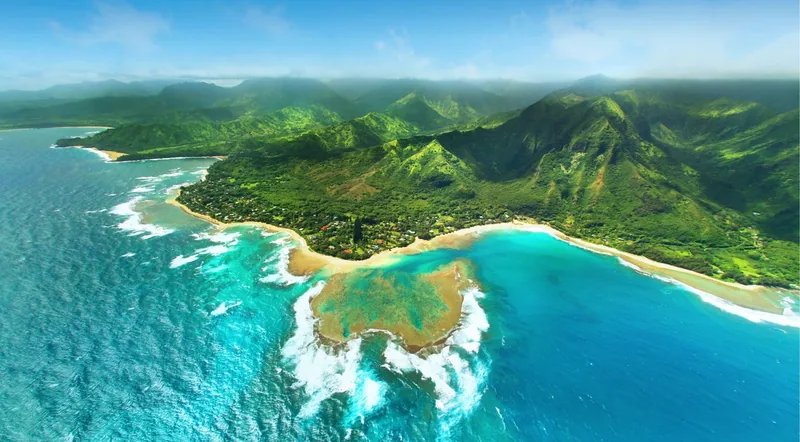 All four islands · compared
Which Hawaiian Island Should You Fly?
Kauai for scenery, Maui for sea cliffs and landings, Oʻahu for short trips and doors-off, the Big Island for volcanic terrain. Our cross-island guide lays out price per minute, doors-off availability, landing tours and the safety record island by island.
Compare all four islands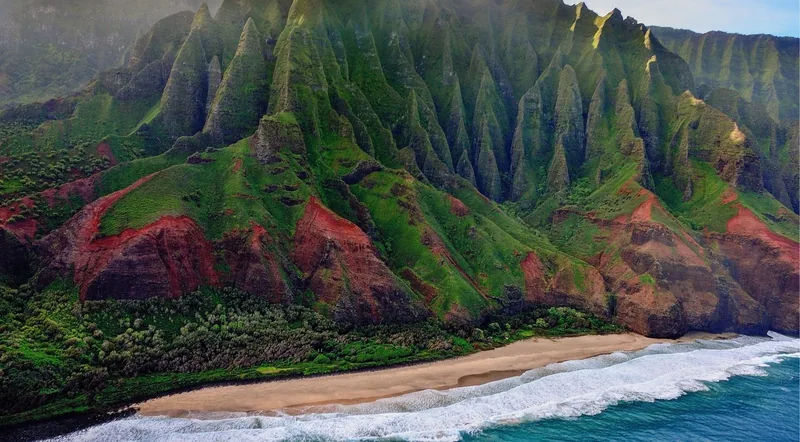 Kauai · the scenery island · full guide
Kauai: Nā Pali, Waimea Canyon and the Jurassic Falls Landing
The island where a flight is the only option — around 70% of it has no road. Home to the real Jurassic Park waterfall and the only tour permitted to land beside it, plus the strongest scenery and the most demanding safety questions in the state.
Read the Kauai guide