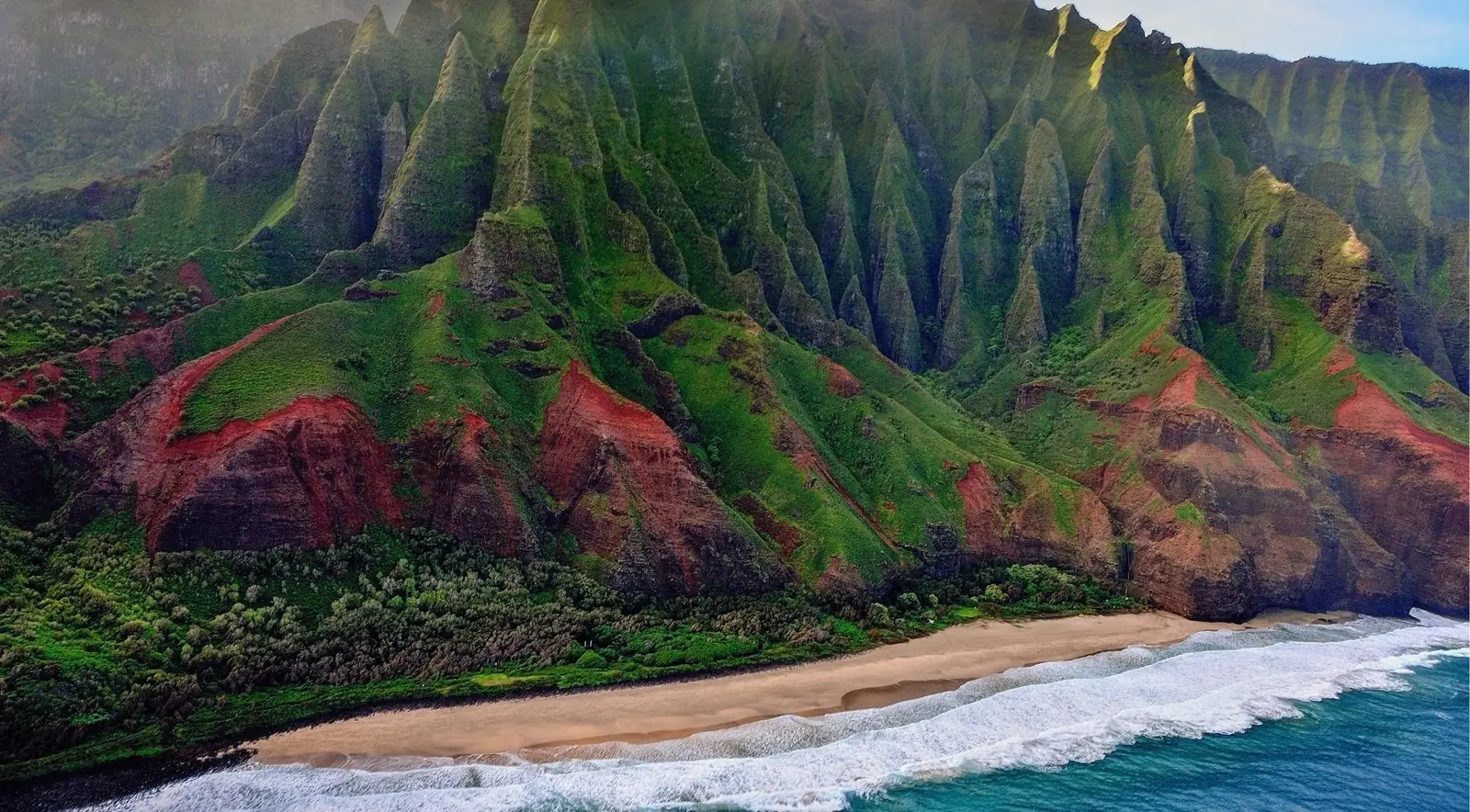
- ~70% of Kauai has no road access
- 45–65 min standard circle-island flight
- $149–$449 fixed-wing to landing tour
- 10–12 min actual time over Nā Pali
- 3 heliports Lihue, Princeville, Port Allen
Why Kauai Is the One Hawaiian Island Where the Flight Is the Point
Every operator on this island sells the same argument, and unusually, it holds up.
There is no road that encircles Kauai. Operators consistently state that around 70% of the terrain is inaccessible by car or on foot — Blue Hawaiian and lovebigisland both use that figure, and some marketing pushes it to 90%. Treat 70% as the working number: it is the widely used one, and the 90% figure appears only in operator marketing. Either way the consequence is the same. The Nā Pali Coast, the Waimea Canyon interior, the Waiʻaleʻale crater and Manawaiopuna Falls are effectively unreachable by any other means.
Standard tours fly a clockwise circle-island route, most of them departing Lihue on the east side, reaching Jurassic Falls early and the Nā Pali Coast around the midpoint. They run 45 to 65 minutes and $280 to $450 per person. The single most sought-after product on the island is Island Helicopters' exclusive Jurassic Falls landing at $449.30, and the cheapest way into the air is a fixed-wing aeroplane from around $149.
One number you should know before you book, because almost no operator leads with it: a helicopter gives you only about 10 to 12 minutes over the Nā Pali Coast. Helicopters typically cut inland roughly a third to halfway along it. If Nā Pali specifically is the thing you came for, that figure is the single most important input into the helicopter-versus-boat decision further down this page.
The Kauai Helicopter Tour We Recommend Starting With
Safari Helicopters out of Lihue — the largest verified review base of any Kauai helicopter flight, covering every landmark on the standard loop.
Lihue: Deluxe Waterfall Safari Helicopter Tour
Why we recommend it: at 485 verified GetYourGuide reviews it has by far the largest review base of any Kauai helicopter flight, and its route covers the complete landmark set — Waimea Canyon, the Nā Pali cliffs, the Waiʻaleʻale crater waterfalls and Jurassic Falls — from around $336.
Safari has flown Kauai for over 30 years out of Lihue, in an AS350 AStar B2 configured with pilot-in-command seat placement so passengers cannot reach the controls. This is the standard circle-island loop done properly: the red and orange eroded walls of Waimea Canyon, the multiple waterfalls cutting through the jungle on the Waiʻaleʻale crater walls, and the Nā Pali cliffs on the northwest shore.
- Waimea Canyon from above — the "Grand Canyon of the Pacific"
- The Nā Pali Coast's rugged red sea cliffs
- Waiʻaleʻale crater and its cascading waterfalls
- Manawaiopuna — the Jurassic Park falls — from the air
- Pilot-guide narration throughout; free cancellation up to 24 hours
Before you book. Safari flies doors-on only, so this is not the photographer's choice — see the doors-off section below for that. Per this tour's own GetYourGuide listing, check-in is one hour before departure and a late arrival forfeits the seat with no refund; any guest at 250 lb or more must buy an additional seat, as must any two guests whose combined weight reaches 420 lb. That is stricter than the 30-to-45-minute check-in typical elsewhere on the island. Note also that Safari was the operator in the fatal December 2019 crash; we cover that in full in the safety section rather than burying it.
What You See From the Air Over Kauai
Nā Pali, Waimea Canyon, the wettest place on earth, and a 400-ft waterfall on private land.
Nā Pali Coast
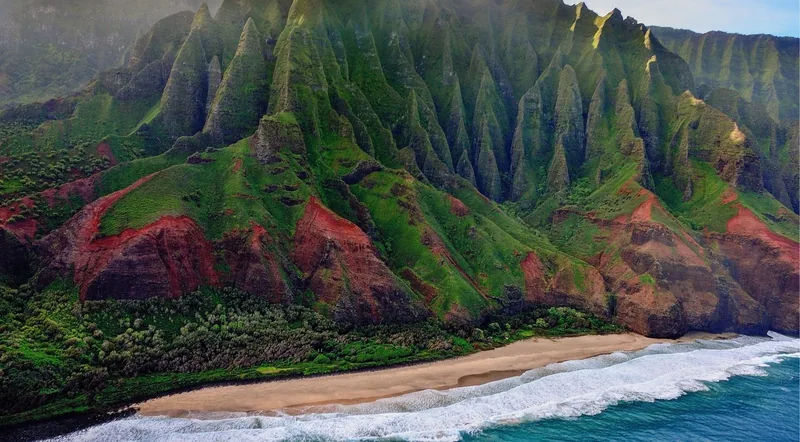
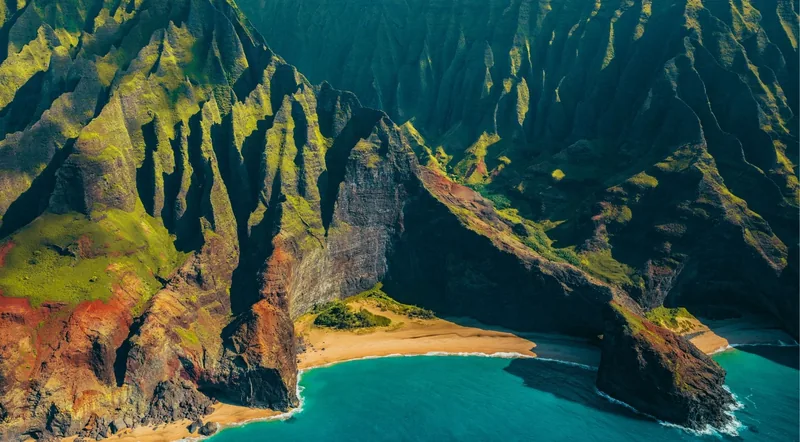
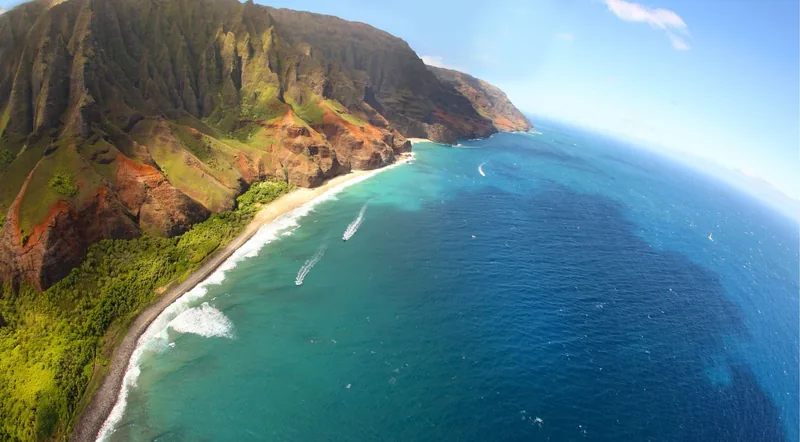
Roughly 16 to 17 miles of northwest coastline — sources cite 15, 16 and 17 — with sea cliffs rising 3,000 to 4,000 ft, hidden valleys at Kalalau, Honopu and Awaawapuhi, and sea caves. Reachable only by air, by boat, or on the strenuous 11-mile Kalalau Trail.
Waimea Canyon
The "Grand Canyon of the Pacific," roughly 10 to 14 miles long and up to about 3,600 ft deep, with red and orange eroded walls and waterfalls including Waipoʻo Falls. You can drive to the rim lookouts; you cannot see the canyon's full run from them.
Mount Waiʻaleʻale and the Weeping Wall
Per Encyclopedia Britannica, "Waialeale is one of the world's wettest spots, averaging some 450 inches (11,430 mm) of rainfall annually. In 1982, 666 inches (16,916 mm) of rain were recorded on the peak, establishing an official record." Thousands of waterfalls line the crater walls — and it is often cloud-shrouded, so treat it as a bonus rather than a promise.
Manawaiopuna — "Jurassic Park" Falls
A 400-ft waterfall in Hanapepe Valley, featured in the 1993 film. It sits on private land, and only one operator is permitted to land there. Every circle-island tour flies past it; only one puts you on the ground beside it.
The rest of the loop
Also on the standard route: Hanapepe Valley and Olokele Canyon; Wailua Falls, of Fantasy Island fame; and the Hanalei Bay north shore — Princeville, Lumahai Beach and Mount Namolokama's waterfalls. One notable exception: Kipu Kai, the remote south-shore beach from 6 Days 7 Nights, is primarily an aeroplane sight. As Wings Over Kauai puts it, helicopters "don't have time for this" — a small but real point in the fixed-wing column.
Other Experiences You Might Enjoy on Kauai
The flight is an hour. These are the things people book around it.
A helicopter tour covers the island in under an hour, which leaves the rest of the week. The obvious pairing is a Nā Pali Coast boat trip — the sea caves and snorkelling a flight cannot give you, and the subject of a full comparison further down this page. On the ground, the Waimea Canyon lookouts and the Kalalau Lookout at Kōkeʻe are free and genuinely good, Wailua Falls is a roadside stop, and Hanalei Bay and Poipu anchor the north and south shores. Here is what else is bookable nearby.
The Jurassic Falls Landing: Kauai's One Genuinely Exclusive Tour
Manawaiopuna Falls sits on private land, and exactly one company may set down beside it.
Island Helicopters, and nobody else
Island Helicopters Kauai is the only operator permitted to land at Manawaiopuna Falls. The waterfall is on private land and the landing right is not shared. Every other operator on this island flies past it. Forty-plus years, owner-operated, out of Lihue.
$449.30, not the $404 you will read elsewhere
The Jurassic Falls Landing Adventure runs 75 to 80 minutes at $449.30 — itemised as $336 base plus $113.30 in fees. Older blog figures of $404 and $432 are out of date. Roughly 20 to 25 minutes of that is on the ground at the falls.
Grand Skies, without the landing
Island's standard Grand Skies Island Tour runs 50 to 55 minutes at $311 — $228 base plus $83 in surcharges and fees. A useful illustration of how much of a Kauai fare is not the headline number.
Island flies doors-on only, deliberately
Island Helicopters flies doors-on exclusively, with an explicit safety rationale: loose items become hazards in an open cabin. If you want the landing, doors-off is not an option — those are two different tours with two different operators.
Book this one early, and book it direct
The Jurassic Falls landing operates only five days a week and sells out in the peak seasons — June to August and December to March. It is not sold on GetYourGuide, so there is nothing for us to link here and nothing for us to earn: book it on islandhelicopters.com. Island markets direct booking specifically to avoid roughly 30% OTA commissions, which is also why you will rarely find it discounted on a reseller.
Safari Helicopters runs the island's other landing tour — the Canyon Landing Safari, about 90 minutes at roughly $369, and the only tour with landing access at the private Kauai Wildlife Refuge overlooking Olokele Canyon, property of Niihau co-owner Keith Robinson. That one is also not sold through GetYourGuide; book it with Safari directly.
Sources: islandhelicopters.com, verified June 2026; safarihelicopters.com; gobackpacking.com; hawaii-guide.com.
Which Type of Kauai Air Tour Should You Book?
Doors-on, doors-off, landing, fixed-wing and private — aircraft, duration and who each one suits.
| Type | Typical aircraft | Duration | Who it suits |
|---|---|---|---|
| Standard doors-on | Airbus EC130 EcoStar or AS350 AStar, 6–7 passengers, air-conditioned | 45–65 min | Floor-to-ceiling windows; families and comfort-oriented flyers |
| Doors-off / open-door | Hughes MD500E (4 pax), AStar, Robinson R44 | 45–65 min | Best photos, no glare; louder, colder, strict no-loose-item rules, minimum age 10 |
| Landing tour | AStar / EC130 | 75–90 min | Jurassic Falls with Island Helicopters (75–80 min, 20–25 min on the ground); Olokele Canyon with Safari (~90 min) |
| Fixed-wing aeroplane | Gippsland GA8 AirVan (6 pax, bubble windows), Cessna 172 | 65–70 min | Cheapest, all-window, smoother, more fuel-efficient — but higher, no hover, no doors-off |
| Private charter & "eco adventure" | Varies | ~50–60 min and up | Blue Hawaiian's Kauai Eco Adventure (50 min, Lihue); private charters for up to 6 from most operators |
Two naming conventions you will meet across operator sites: "AStar" is the Airbus (formerly Eurocopter) AS350, and "EcoStar" is the EC130 / H130. Both terms appear interchangeably.
Who Flies Kauai in 2026
Aircraft, heliport, doors-off availability and what each one is actually known for.
Blue Hawaiian Helicopters
Airbus EC130 EcoStar, 6 passengers, doors-on only. Holds FAA Part 135, was the first US company certified under TOPS, also holds HAI Platinum, is pursuing IS-BAO, and runs an FAA-approved Safety Management System and ASAP. Flies from both Lihue and Princeville. Tours: Kauai Eco-Adventure (~50 min, Lihue) and Discover Kauai (Princeville). Pricing from the reseller LeaLea Tours puts Lihue at $409–$429 and Princeville at $459–$479, with a front-row upgrade around $150 a seat — those are reseller figures, so verify them against bluehawaiian.com before booking. It had a non-fatal EC130 hard landing near Hanalei in January 2016, with all aboard surviving.
Our picks on GetYourGuide: the Kauai Eco Adventure — 5.0 from 46 reviews, from $409, the highest-rated flight anywhere on this site, and from the north shore the Discover Kauai from Princeville — 4.5 from 15 reviews, from $459. Be aware that the Princeville flight is the lowest-rated tour we list anywhere, on a thin base of 15 reviews — read the recent ones carefully. Its value is convenience if you are staying north, not quality.
Island Helicopters Kauai
The only operator permitted to land at Jurassic Falls. Forty-plus years, owner-operated, Lihue, doors-on only by explicit safety choice. Grand Skies Island Tour 50–55 min at $311; Jurassic Falls Landing Adventure 75–80 min at $449.30. Markets direct booking to avoid roughly 30% OTA commissions. Not sold on GetYourGuide — book at islandhelicopters.com.
Jack Harter Helicopters
The doors-off pioneer, founded 1962 and described as the "originator of helicopter tours on Kauai." Fleet: a 6-passenger AS350 AStar doors-on and a 4-passenger Hughes MD500E doors-off with an FAA-required quick-release harness. Lihue, 60–65 minute tours — the company argues 60 minutes should be the minimum for a genuine full-island tour. Doors-off runs roughly $375–$450. Flag: the doors-on AStar is out for scheduled upgrades through November 2026, so doors-on bookings are unavailable in that window; the doors-off Hughes 500 is still flying.
Safari Helicopters
Thirty-plus years at Lihue, flying the AStar B2 with pilot-in-command seat placement that prevents passengers reaching the controls. Deluxe Waterfall Safari (~55–60 min) from around $309 booked direct, or $336 on GetYourGuide; Canyon Landing Safari (~90 min) around $369 — the only landing access at the private Kauai Wildlife Refuge above Olokele Canyon. This was the operator in the fatal 26 December 2019 crash, covered in full below.
Our picks on GetYourGuide: our featured Deluxe Waterfall Safari — 4.8 from 485 reviews, from $336, and the Waimea Canyon, Jurassic Falls and more flight — 4.8 from 322 reviews, from $369, which adds the rare and endangered plant terrain of Olokele Canyon.
Air Kauai / Air Ventures Hawaii
Doors-off in the AStar, from Lihue. Provides windbreaker jackets and runs a strict cell-phone-only camera policy — no other cameras at all. Comfort seat required at 240 lb individually or 420 lb combined; the edge seat is 16 and over.
Our pick on GetYourGuide: the Entire Kauai Air Tour with Window Seats — 4.8 from 652 reviews, from $159. At that price and with window seats specified it is an air tour rather than a helicopter flight, and it carries a 300 lb per-passenger limit; confirm the aircraft with the operator if that matters to you.
Mauna Loa Helicopter Tours
On Kauai since 2006, doors-off by default with doors-on optional, photography-focused, serving Princeville, Lihue and Waimea, with private tours for two to three passengers. Not sold on GetYourGuide.
Maverick Helicopters
Confirmed operating on Kauai — expanded from Maui around 2019 and showing active 2026 Kauai reviews. It is the only operator flying from Port Allen Airport on the south shore near Poipu, in an EC130 EcoStar for up to 7 passengers with "Quiet Technology" and air conditioning. The Kauai Explorer runs about 50 minutes. Flag: Maverick's own site was not displaying a live Kauai per-person price as of August 2026; third-party and possibly stale figures range $269–$384. Call Port Allen to confirm before you plan around a price.
Wings Over Kauai
Fixed-wing aeroplane from the Lihue commuter terminal. The GA8 AirVan seats 6 with no middle seats — every seat is a window — and the "Grand Deluxe" runs about 65 minutes at $149 per person plus 6% tax on a seasonal special. A Cessna 172 private flight for 2 to 3 is about $179 online, $189 regular, plus 6%; an AirVan private charter is around $676.
Our pick on GetYourGuide: the Air Tour of the Nā Pali Coast and Entire Island — 4.9 from 1,101 reviews, from $155, the most-reviewed air tour on the whole site.
Two operators you should not book right now
- Airborne Aviation Tours — doors-off, flew a 1979 Hughes/MD 500. Suspended operations indefinitely after the fatal 26 March 2026 crash. Do not book, and be wary of any reseller still listing it.
- Inter-Island Helicopters — multiple forum reports say they are no longer flying tours. Confirm directly before relying on a listing.
Separately, Aliʻi Air / Aliʻi Kauai Air Tours — private doors-off, all-window seats, from Lihue — is still listed as operating. One fact to weigh: the fatal 11 July 2024 Nā Pali crash that killed three was an Alii Kauai Air Tours Robinson R44, an in-flight breakup after turbulence that the NTSB attributed to a known R44 main-rotor wobble and mast-strike tendency in high winds. The NTSB also notes the R44 had the highest fatal accident rate among major helicopter makes between 2006 and 2016. Ask which aircraft type you would be flying.
What a Kauai Air Tour Costs in 2026
The advertised "from" price is frequently not the all-in price. Here is where the rest of it hides.
| Tour type | Representative price | Operator |
|---|---|---|
| Standard 50–60 min circle island (doors-on) | ~$280–$430 | Island Helicopters Grand Skies $311; Blue Hawaiian Eco-Adventure $409–$429; Safari Deluxe from $309 |
| Doors-off | ~$360–$450 | Jack Harter ~$399 for 60 min; Adrenaline listing ~$360 |
| Waterfall landing — Jurassic Falls | $449.30 (75–80 min) | Island Helicopters, exclusive |
| Canyon landing — Olokele | ~$369 (~90 min) | Safari |
| Fixed-wing aeroplane | $149 plus 6% (AirVan); ~$179 (Cessna) | Wings Over Kauai |
| Private charter | Varies — ~$676 AirVan | Multiple; Blue Hawaiian Princeville private for up to 6 |
The fuel surcharge is handled inconsistently
Some operators bundle it: Island Helicopters itemises about $83 of its $311 Grand Skies fare as surcharges and fees, and Air Kauai states its price "includes all taxes, fees, and fuel surcharge." Others add fuel surcharge and tax at checkout, which means an advertised "from" price is often not all-in. Confirm the total before you pay, on every quote.
The weight-based comfort seat
Passengers at 240 to 250 lb, or pairs at 400 to 420 lb combined, must buy an extra "comfort seat." Front-middle seats are often capped at 150 lb and 5'10". Every passenger is weighed at check-in under FAA weight-and-balance rules — as Island Helicopters points out, helicopters, unlike commercial jets, cannot use average adult weights. The industry benchmark for the surcharge is 50 to 100% of the fare.
The front seat
Blue Hawaiian charges around $150 a seat for its "First Class Front Row." Some operators will take a request but guarantee nothing — and on a doors-off flight in a smaller aircraft like the Hughes 500 or R44, a window or front seat is far more often guaranteed by default.
Booking platforms and the 30% question
Viator and FareHarbor may add booking fees. Several operators — Island Helicopters most vocally — push direct booking specifically to avoid roughly 30% OTA commissions. Where we link a tour on this page we earn a commission; where an operator sells only direct, we say so and send you to them, as with the Jurassic Falls landing above.
Where to Fly From: Lihue, Princeville or Port Allen
Choose the one nearest your lodging — but know that it changes when Nā Pali appears.
Lihue Airport heliport — east and central
The hub. Island Helicopters, Jack Harter, Safari, Air Kauai/Air Ventures, Blue Hawaiian's Eco-Adventure, Mauna Loa and Wings Over Kauai all fly from here. Best for east, south and central lodging. On a Lihue departure, Nā Pali appears roughly halfway through the loop.
Princeville — north
Blue Hawaiian's Discover Kauai and some Mauna Loa flights. Best if you are staying on the north shore. On a Princeville departure, Nā Pali comes at the start and end of the loop rather than the middle.
Port Allen — south, near Hanapepe and Poipu
Maverick Helicopters only. The most convenient departure if you are staying on the south shore or at Poipu — and the reason to bother verifying Maverick's current pricing by phone.
The circle-island content is broadly similar from all three. What changes is the order in which you see things — which matters mostly for light and for where in the flight your camera battery is freshest.
When to Fly Kauai: AM for Calm, PM for Light
Nā Pali faces west and sits in shadow in the morning. That is a genuine trade-off, not a technicality.
Morning: calmer, clearer, kinder
Morning is generally the safest bet — calmer air, clearer skies, fewer interior clouds building, and less turbulence. If you are a nervous or first-time flyer, or prone to motion sickness, this is the slot to take. It is also the slot most likely to actually show you Waiʻaleʻale before the cloud closes in.
Afternoon: better light, bumpier ride
Afternoon and midday deliver better light on the Nā Pali Coast, which sits in shadow in the morning, plus dramatic canyon shadows. Better for photography, worse for comfort: clouds build and the air gets bumpier. Jack Harter's own staff and travel writers including Earth Trekkers and Never Ending Voyage specifically recommend midday or early afternoon for Nā Pali light. The trade-off is real and there is no right answer — pick based on whether you are shooting or sightseeing.
Season
Driest roughly April to October, which means fewer cancellations. November to March is wetter but produces fuller waterfalls. Summer overlaps hurricane season, and June is often cited as the strongest balance of the two.
Cancellations are common here — plan for one
Kauai's fast-changing microclimates make weather cancellations common. Operators typically offer a full refund or a reschedule — Jack Harter and Mauna Loa both give full refunds. Customer-initiated cancellation windows are often 48 hours. Book early in your trip so a scrubbed flight can actually be rebooked.
Kauai Helicopter Safety: The Record, the Rules and What to Ask
This island has the worst air-tour safety record in the state. That is a reason to choose carefully, not a reason to be frightened.
Part 135, Part 136 and the 1,500 ft floor
Air tours operate under FAA 14 CFR Part 135. SFAR 71, issued 26 September 1994 and effective 1997, established a 1,500 ft minimum altitude; its substance now lives in 14 CFR Part 136, where §136.75(d)(1) requires at least 1,500 ft above the surface unless authorised. Operators can obtain an OpSpec/LOA B048 to descend below minimums with an approved safety plan; B057 governs national-park overflights.
A 47% drop in the crash rate
Per Outside Online: "A study compared crashes between 1981-1994 with those between 1995 and 2008 and found the enactment of SFAR No. 71 was followed by a 47 percent decrease in crash rates, with the number of crashes into the ocean dropping from eight to one." In 2024 the FAA published a consistent new process letting Hawaii operators get authorisation to descend below altitude minimums specifically to avoid bad weather — in Acting Associate Administrator David Boulter's words, "to prevent situations where pilots encounter poor visibility and become disoriented."
85+ deaths, and where they happened
Per AVweb in April 2026, Hawaii "leads the nation in fatal air tour accidents, with more than 85 deaths recorded since the NTSB began tracking the data." Per Honolulu Civil Beat, also April 2026: "Fifty-one people have died in helicopter crashes since 2000… The Kalalau Beach accident was the 13th fatal helicopter crash in Hawaiʻi in 25 years and nine of those –– including the three most recent fatal accidents –– have been on Kauaʻi." Representative Ed Case, in an April 2025 FAA comment letter: "Between 2006 and 2024, there have been 31 fatal aircraft crashes in Hawaiʻi."
One in ten visitors takes an air tour
Context matters as much as the count. Per Outside Online, "more than 1 million people take an aerial tour of Hawaiʻi each year, equating to one out of every 10 visitors to the islands." The accidents above are rare events against a very large denominator. They are also, repeatedly, the same accident: a pilot continuing into deteriorating weather.
26 December 2019 — Safari Aviation, near Kekaha: 7 killed
An Airbus AS350 B2 (N985SA) operated by Safari Aviation, trading as Safari Helicopters, crashed about 24 miles northwest of Lihue near Kekaha and Kōkeʻe. Pilot Paul Matero, 69, and all six passengers died — seven in total. It was the pilot's eighth and final 50-minute flight of the day.
The NTSB final report of 10 May 2022 (NTSB/AIR-22-05) faulted the pilot's decision to continue into deteriorating weather — three other tour pilots diverted that day — and the FAA's failure to adopt prior NTSB recommendations, including installing weather cameras on Kauai and requiring in-flight weather training and safety management systems. NTSB Chair Jennifer Homendy: "The fact is that this tragedy should never have occurred. It was 100% preventable."
The broader NTSB finding is the one worth carrying away: "Since 1997, the NTSB has investigated 41 air tour accidents in Hawaii, 15 of which were fatal… 9 involved a pilot's decision to continue flight under visual flight rules (VFR) into instrument meteorological conditions (IMC). Those nine accidents resulted in 51 deaths."
26 March 2026 — Airborne Aviation, off Kalalau Beach: 3 killed
A 1979 Hughes/MD 500 (tail N715KV, roughly 50 years old) operated by Airborne Aviation Tours crashed into the ocean about 100 yards off Kalalau Beach, roughly 27 minutes into a tour from Lihue. Three were killed — Margaret Rimmler, 65, and Patrick Haskell, 59, of Massachusetts, and Oksana Pihol, 40, a Ukrainian national — and two injured, from one pilot and four passengers aboard.
The pilot reportedly reported severe vibrations and loss of directional control during a turn, and preliminary data showed a descent from about 3,000 ft to near sea level within minutes. The company suspended operations indefinitely. The NTSB preliminary report was released on 18 April 2026.
The prior fatal Nā Pali crash, a Robinson R44 on 11 July 2024, was attributed by the NTSB to a known R44 main-rotor wobble and mast-strike tendency in high winds.
What TOPS means, and the seven questions to ask
TOPS — the Tour Operators Program of Safety — is a voluntary industry "gold standard," in the words of safety auditor Keith Cianfrani. It requires pilots to hold at least 1,000 hours pilot-in-command plus 100 hours in the specific terrain, to be instrument-rated, and it mandates independent annual external audits and emergency equipment beyond FAA requirements. Among major Kauai operators, Blue Hawaiian is the notable TOPS member, audited September 2023. IS-BAO and VAI (Vertical Aviation International) are the other recognised standards.
Before you book, ask: does the operator hold an FAA Part 135 certificate? Is it a TOPS or IS-BAO member? What are the pilots' total hours and Kauai-terrain experience? Is there a documented Safety Management System? What aircraft type and age? For doors-off, is an FAA-required quick-release harness used? What is the weather cancellation policy? Cianfrani adds one more heuristic worth having: book operators used by cruise lines and large hotels, which vet their vendors.
Sources: NTSB report AIR-22-05 (ntsb.gov); Honolulu Civil Beat, April 2026; AVweb, April 2026; Outside Online; FAA Advisory Circular AC 136-4 and faa.gov newsroom; Travel Weekly; Aviation Law Group; hawaiinewsnow.com, mauinow.com, westhawaiitoday.com, bigislandnow.com, cbsnews.com and beatofhawaii.com.
Doors-Off on Kauai: Better Photos, Stricter Rules
Several operators fly it here — and the operator with the landing tour deliberately does not.
What doors-off gives you
- No window glare or reflections — the whole reason photographers pay for it
- More thrill and a more immersive flight
- In a smaller aircraft (Hughes 500, R44) a window or front seat is far more often guaranteed
- Available from Jack Harter (the pioneer, since 1962), Air Kauai / Air Ventures and Mauna Loa
What it costs you
- Louder and colder — cabins run roughly 10–15°F cooler, windy, sometimes misty
- Minimum age 10, and 16 for the edge or outboard seat
- No hats, beanies or headwear; no bags, backpacks or purses; nothing loose
- Not for the claustrophobic or nervous — and Island Helicopters, the landing operator, flies doors-on only by choice
The camera rules differ by operator, and they are stricter than you expect
Cameras and phones must be tethered with a wrist or neck strap. GoPros and selfie sticks are restricted — Jack Harter bans sticks over 12 inches, and magnetic gimbals are allowed only with an extra strap. Air Kauai allows only cell phones, on a provided lanyard, and no other cameras at all. If you were planning to bring a DSLR, check the specific operator's policy before you book, not at check-in.
Dark or black clothing cuts glare and reflection in photos — avoid white. That applies even doors-off, because the windshield remains.
Booking and Preparing for a Kauai Air Tour
What to wear, what is banned, who gets weighed, and which seat to avoid.
Book in advance — and early in your stay
Especially the Jurassic Falls landing, which runs only five days a week and sells out in June to August and December to March, plus morning and doors-off slots generally. Book early in your stay so a weather cancellation can be rebooked.
What to wear
Dark or black clothing to cut window glare — avoid white, even doors-off. Long sleeves and trousers. Closed-toe shoes strapped to the foot, mandatory doors-off: no flip-flops, no slip-ons. A light, ideally waterproof jacket — several operators provide windbreakers. Long hair tied in a bun or braid.
Banned on doors-off
No hats, beanies or headwear. No bags, backpacks or purses. Nothing loose at all. Cameras and phones must be tethered to a wrist or neck strap. GoPros and selfie sticks are restricted, and some operators are cell-phone-only.
Weight and size
All passengers are weighed at check-in. A comfort seat is required at 240 to 250 lb individually or 400 to 420 lb combined. Front-middle seats are often capped at 150 lb and 5'10".
Check-in
Typically 30 to 45 minutes before departure — Blue Hawaiian requires a full hour, as does Safari on the flight we feature. Government ID is required. A late check-in is treated as a no-show and is non-refundable.
Children and infants
Lap infants under 24 months are often free on doors-on tours, with a maximum of one lap child per tour at Island Helicopters. Doors-off minimum age is 10, and 16 for the edge seat. Minors must be accompanied by an adult, and children under 35 lb may need an infant life preserver.
Motion sickness
Choose a morning flight, when the air is calmest, and pre-medicate. This is the one factor that should override the afternoon-light argument if you are susceptible.
Seat choice: avoid back-left
The back-left seat, behind the pilot, has the worst Nā Pali views, per ExploreWithAlec. The front seat can sometimes be requested or paid for — around $150 at Blue Hawaiian. Doors-off in a smaller aircraft more often guarantees a window or front seat by default.
Accessibility
Fixed-wing with Wings Over Kauai requires climbing two to three steps, with staff assistance; helicopter cabins require climbing up. Some operators have accommodated wheelchair users per traveller reviews — confirm case by case rather than assuming.
Helicopter vs Boat, vs Aeroplane, vs Doors-On — and the Oʻahu Day Trip
Straight answers, including the one where the helicopter loses.
Helicopter vs Nā Pali boat tour
A boat — catamaran or raft, roughly 4 to 5 hours, $211 to $388 — gets you to sea level: into the sea caves, snorkelling, dolphins and turtles, with cultural narration. It is more immersive, but carries seasickness risk and seasonal limits, with north-shore departures running only in summer because of winter swell. A helicopter, 50 to 60 minutes, shows you the whole island including the inaccessible interior — Waimea Canyon, Waiʻaleʻale, the interior waterfalls — but gives you only about 10 to 12 minutes over Nā Pali. Forum consensus: do both if you can. If you must choose and Nā Pali specifically is the goal, many prefer the boat. For the interior and comprehensiveness, the helicopter wins.
Helicopter vs fixed-wing aeroplane
The aeroplane is cheaper — $149 against $300 to $450 — all-window with no middle seat, smoother, more fuel-efficient, and spends more time over some sights including Kipu Kai and the Poipu shoreline. But it flies higher, cannot hover into valleys or craters, and offers no doors-off. The helicopter is more manoeuvrable, flies lower, hovers, and is the only one with an open-door option. On this island the aeroplane is a genuinely good-value answer rather than a consolation prize.
Doors-off vs doors-on
Doors-off: better photos with no glare, more thrill — but louder, colder, with strict restrictions, a minimum age of 10 and tethered cameras. Not for the claustrophobic or nervous. Doors-on: air-conditioned, quieter, family-friendly, and still floor-to-ceiling windows. Worth noting that Island Helicopters flies doors-on only and argues the case — that loose items become hazards in an open cabin.
Can you day-trip from Oʻahu?
Yes, but not the way people imagine. There is no direct sightseeing helicopter from Oʻahu to Kauai. You take an inter-island fixed-wing flight, Honolulu to Lihue, about 40 minutes, and then the air tour on Kauai. Packaged day trips do exist, bundling round-trip airfare with a roughly 45-minute helicopter tour and a guided ground tour — a sample day departs Waikiki around 5:30 a.m., flies Honolulu to Lihue at 7:25 a.m., runs the helicopter tour around 2:20 p.m. and returns at 4:45 p.m. Separately, Paradise Helicopters advertises inter-island helicopter transfers — point-to-point transport, not sightseeing tours — though Paradise ceased all operations on 4 May 2024 per Hawaii News Now, KITV and lovebigisland, so treat its still-live website as stale.
What's New, and What Is Still Unresolved
A new lodging tax, a pending altitude fight, and a noise debate that is not going away.
-
The Hawaii "Green Fee" took effect on 1 January 2026
Act 96 (SB 1396), signed by Governor Josh Green on 27 May 2025, raised the state Transient Accommodations Tax by 0.75% to 11%. Combined with county surcharges of up to 3% and the general excise tax of roughly 4 to 4.5%, total lodging tax now approaches 19% — among the highest in the nation. It is projected to raise about $100M a year for climate resilience, wildfire prevention and shoreline restoration. The cruise-ship portion was blocked by a Ninth Circuit injunction on 31 December 2025, with the appeal pending. It applies to lodging, not to air tours directly — but it raises your overall trip cost.
-
Blue Hawaiian's 700-ft altitude petition is still undecided
Blue Hawaiian petitioned the FAA under docket FAA-2025-0301 for an exemption to fly as low as 700 ft AGL in specified areas across Hawaiʻi Island, Oʻahu, Maui and Molokaʻi — including some Kauai razorback-ridge crossings. It drew roughly 55,000 public comments, largely opposed, including a formal objection from Representative Ed Case on 8 April 2025 and from the Maui Tomorrow Foundation. Blue Hawaiian argues that flying lower is safer, keeping aircraft below the roughly 1,500-ft cloud deck, and cites 700,000+ tour hours since 2000 without a weather-related accident. As of late October 2025 the FAA had not decided, and no ruling has surfaced since.
-
The noise debate is louder on Kauai than anywhere else
Residents around Kōkeʻe, Kalalau and Waimea Canyon report 25 or more flights an hour. Representative Ed Case has repeatedly pushed the Safe and Quiet Skies Act. Jurisdiction is split and that is why little changes: the FAA is the sole regulator of flight paths, while the state — per a 2021 FAA letter to the DLNR — is limited to airport-proprietor noise rules. Kauai has no national park, so the Air Tour Management Plans that slashed overflights at Hawaiʻi Volcanoes and Haleakalā do not apply here — but they signal the regulatory direction.
-
Three operator changes to check before you book
Airborne Aviation Tours is suspended indefinitely since the March 2026 fatal crash — do not book it. Inter-Island Helicopters is reportedly no longer flying tours. Jack Harter's doors-on AStar is out for upgrades through November 2026, though the doors-off Hughes 500 is still flying. And Maverick's Kauai operation is active but had no live online price as of August 2026 — call Port Allen.
Sources: hawaiimagazine.com, beatofhawaii.com, abc27.com and forbes.com on the Green Fee; staradvertiser.com, khon2.com, civilbeat.org, hawaiinewsnow.com and case.house.gov on the FAA petition; outsideonline.com, civilbeat.org and dlnr.hawaii.gov on noise and jurisdiction; verticalmag.com, tripadvisor.com and yelp.com on operator status.
Kauai Helicopter Tours in Photos
Scroll or drag to browse.
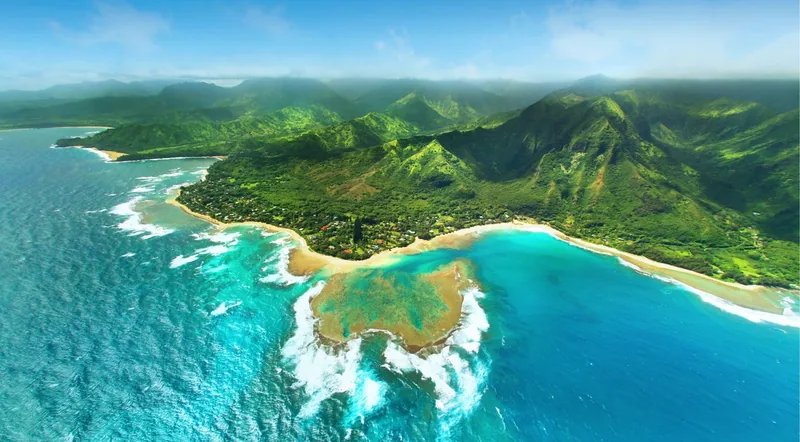
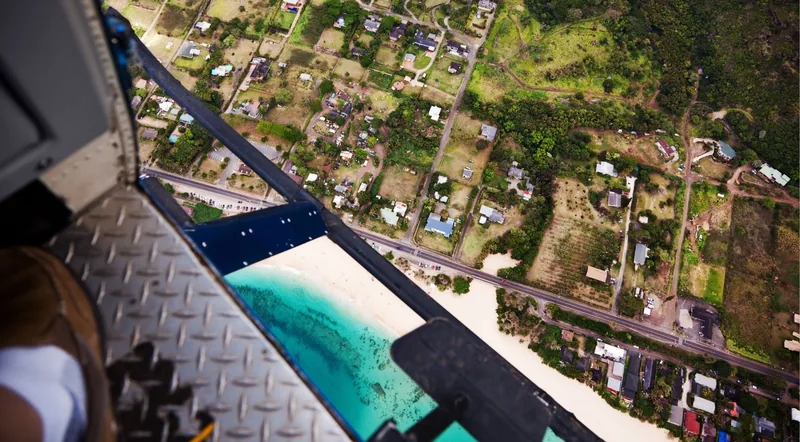
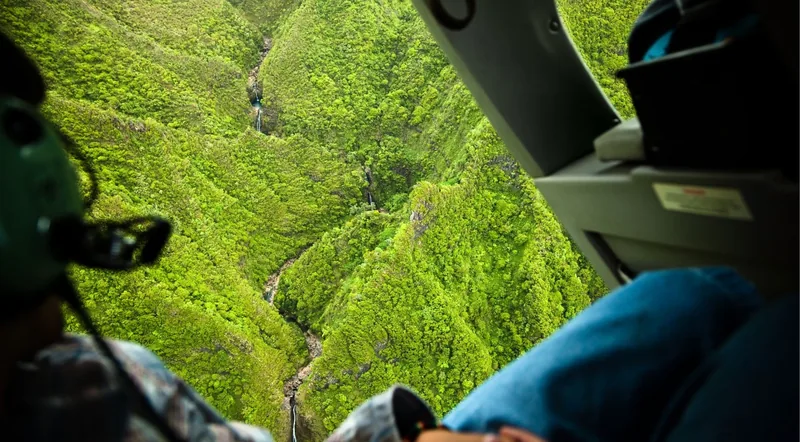
Kauai Helicopter Tours: Common Questions
Jurassic Falls, prices, doors-off, safety and the boat-versus-helicopter call.
Are Kauai helicopter tours worth it?
On this island, more than anywhere else in Hawaii, yes — and for a specific reason. No road encircles Kauai, and around 70% of it is inaccessible by land. The Nā Pali Coast, the Waimea Canyon interior, the Waiʻaleʻale crater and Manawaiopuna Falls cannot be reached any other way. Some operator marketing pushes the figure to 90%; 70% is the widely used number and the one to trust. If your budget only stretches to one air tour in Hawaii, this is the island to spend it on.
How much does a Kauai helicopter tour cost?
A standard 50 to 60 minute doors-on circle-island flight runs $280 to $430 — Island Helicopters' Grand Skies is $311, Safari's Deluxe from $309, Blue Hawaiian's Eco-Adventure $409 to $429. Doors-off runs $360 to $450. The exclusive Jurassic Falls landing is $449.30, and Safari's Olokele canyon landing about $369. The cheapest way into the air is a fixed-wing aeroplane from $149 plus 6% tax. Watch the fees: some operators bundle the fuel surcharge and some add it at checkout, so an advertised "from" price is often not the total.
Which Kauai helicopter tour lands at Jurassic Park falls?
Island Helicopters Kauai, and only Island Helicopters. Manawaiopuna Falls — the 400-ft waterfall in Hanapepe Valley from the 1993 film — sits on private land, and Island holds the sole landing permission. The Jurassic Falls Landing Adventure runs 75 to 80 minutes at $449.30, itemised as $336 plus $113.30 in fees, with roughly 20 to 25 minutes on the ground. Older figures of $404 or $432 that you will find on blogs are out of date. It operates only five days a week and sells out June to August and December to March, so book early — and book direct at islandhelicopters.com, since it is not sold through the booking platforms.
How long do you actually spend over the Nā Pali Coast?
Only about 10 to 12 minutes on a helicopter tour — helicopters typically cut inland roughly a third to halfway along the coast. This is the number almost no operator leads with, and it is the single most important input into the helicopter-versus-boat decision. The coast itself runs roughly 16 to 17 miles, with sea cliffs of 3,000 to 4,000 ft. If Nā Pali specifically is what you came for, a boat trip gives you far more time with it; if you want the whole island including the interior, the helicopter is the one.
Helicopter or boat for the Nā Pali Coast?
Do both if you can — that is the genuine forum consensus. A boat (catamaran or raft, 4 to 5 hours, $211 to $388) gets you to sea level, into the sea caves, snorkelling with dolphins and turtles, with cultural narration — but carries seasickness risk and seasonal limits, with north-shore departures only in summer. A helicopter (50 to 60 minutes) shows the whole island including the interior that no boat reaches — Waimea Canyon, Waiʻaleʻale, the inland waterfalls — but gives you only 10 to 12 minutes over Nā Pali itself. For Nā Pali specifically, many prefer the boat; for comprehensiveness, the helicopter.
Is the fixed-wing aeroplane tour a downgrade?
Not on Kauai. The aeroplane is cheaper ($149 against $300 to $450), all-window with no middle seat, smoother and more fuel-efficient, and it actually spends more time over some sights — including Kipu Kai, the 6 Days 7 Nights beach that Wings Over Kauai says helicopters "don't have time for." The trade-offs are real: it flies higher, cannot hover into valleys or craters, and there is no doors-off option. Take the aeroplane if budget or motion sickness is the constraint; take the helicopter if you want to drop into the Waiʻaleʻale crater.
What is the best time of day to fly Kauai?
This is the one island where "always fly mornings" breaks down. Morning gives calmer air, clearer skies, fewer interior clouds and less turbulence — the right call for nervous flyers, the motion-sick, and anyone hoping to actually see Waiʻaleʻale before cloud closes in. But the Nā Pali Coast faces west and sits in shadow in the morning, so afternoon and midday deliver noticeably better light on it, plus dramatic canyon shadows. Jack Harter's staff, Earth Trekkers and Never Ending Voyage specifically recommend midday or early afternoon for Nā Pali photography. AM for calm and clarity, PM for light.
How safe are Kauai helicopter tours?
Kauai has the worst record in the state, and you should book knowing it. Per Civil Beat in April 2026, "the Kalalau Beach accident was the 13th fatal helicopter crash in Hawaiʻi in 25 years and nine of those –– including the three most recent fatal accidents –– have been on Kauaʻi." AVweb puts Hawaii at more than 85 deaths since NTSB tracking began. Against that, more than a million people take a Hawaii air tour each year — one in ten visitors. The recurring cause is a pilot continuing into deteriorating weather: of 41 Hawaii air-tour accidents the NTSB has investigated since 1997, 15 were fatal and nine involved VFR flight into instrument conditions. Choose an operator on its Part 135 certificate, TOPS or IS-BAO membership, pilot hours and weather-cancellation policy — not on price.
Which Kauai operator is the safest choice?
There is no certified ranking, but there is one objective marker. Among major Kauai operators, Blue Hawaiian is the notable TOPS member — the Tour Operators Program of Safety, audited September 2023, requiring pilots to hold at least 1,000 hours pilot-in-command plus 100 hours in the specific terrain, to be instrument-rated, and mandating independent annual external audits and extra emergency equipment. Beyond that, ask any operator: Part 135 certificate? Documented Safety Management System? Pilot hours and Kauai-terrain experience? Aircraft type and age? Weather-cancellation policy? Safety auditor Keith Cianfrani adds a useful shortcut — book operators used by cruise lines and large hotels, which vet their vendors.
What are the doors-off rules on Kauai?
Strict, and stricter than most people expect. Minimum age 10, and 16 for the edge or outboard seat. No hats, beanies or headwear; no bags, backpacks or purses; nothing loose at all. Cameras and phones must be tethered to a wrist or neck strap. Jack Harter bans selfie sticks over 12 inches and allows magnetic gimbals only with an extra strap; Air Kauai allows cell phones only, on a provided lanyard, and no other cameras. Closed-toe shoes strapped to the foot are mandatory, hair must be tied up, and cabins run 10 to 15°F cooler and windy. Jack Harter, Air Kauai/Air Ventures and Mauna Loa all fly doors-off; Island Helicopters deliberately does not.
Do they weigh you, and what if I am over the limit?
Yes — every passenger is weighed at check-in under FAA weight-and-balance rules. As Island Helicopters explains it, helicopters, unlike commercial jets, cannot use average adult weights. A comfort seat is required at 240 to 250 lb individually or 400 to 420 lb combined, and the industry benchmark for that surcharge is 50 to 100% of the fare. Front-middle seats are often capped at 150 lb and 5'10". Give accurate weights when you book rather than at the desk.
Should I fly from Lihue, Princeville or Port Allen?
Choose the one nearest your lodging — the circle-island content is broadly similar, but the order differs. Lihue is the hub, with Island Helicopters, Jack Harter, Safari, Air Kauai, Blue Hawaiian's Eco-Adventure, Mauna Loa and Wings Over Kauai; Nā Pali appears roughly halfway through the loop. Princeville serves the north shore, with Blue Hawaiian's Discover Kauai and some Mauna Loa flights; Nā Pali comes at the start and end. Port Allen on the south shore near Poipu is Maverick only.
Can you take a helicopter from Oʻahu to Kauai?
No. There is no direct sightseeing helicopter from Oʻahu to Kauai. You take an inter-island fixed-wing flight, Honolulu to Lihue, about 40 minutes, and then the air tour on Kauai. Packaged day trips bundle round-trip airfare with a roughly 45-minute helicopter tour and a guided ground tour — a sample itinerary departs Waikiki around 5:30 a.m., flies at 7:25 a.m., runs the helicopter around 2:20 p.m. and returns at 4:45 p.m. Paradise Helicopters advertises inter-island helicopter transfers, which are point-to-point transport rather than sightseeing, but Paradise ceased all operations on 4 May 2024, so treat its still-live website as stale.
What happens if my flight is cancelled for weather?
Weather cancellations are common on Kauai because of the island's fast-changing microclimates. Operators typically offer a full refund or a reschedule; Jack Harter and Mauna Loa both give full refunds. Customer-initiated cancellation windows are often 48 hours. The practical advice: book early in your trip so a scrubbed flight can be rebooked before you fly home, and never book your only air tour for your last morning.
More Hawaii Helicopter Tours
Kauai is the scenery island. The others do different jobs.
All four islands · compared
Which Hawaiian Island Should You Fly?
Kauai for scenery, Maui for sea cliffs and landings, Oʻahu for short trips and doors-off, the Big Island for volcanic terrain. Our cross-island guide lays out price per minute, doors-off availability, landing tours and the safety record island by island.
Compare all four islands Big Island · the volcanic one · full guide
Big Island: Kīlauea, Hualālai and the Kona Coast
The opposite island in almost every way — lava country rather than green cliffs, and the one place where a national-park Air Tour Management Plan now bars every route from crossing the volcano's summit. Current eruption status, Hilo versus Kona, and all five operators.
Read the Big Island guide